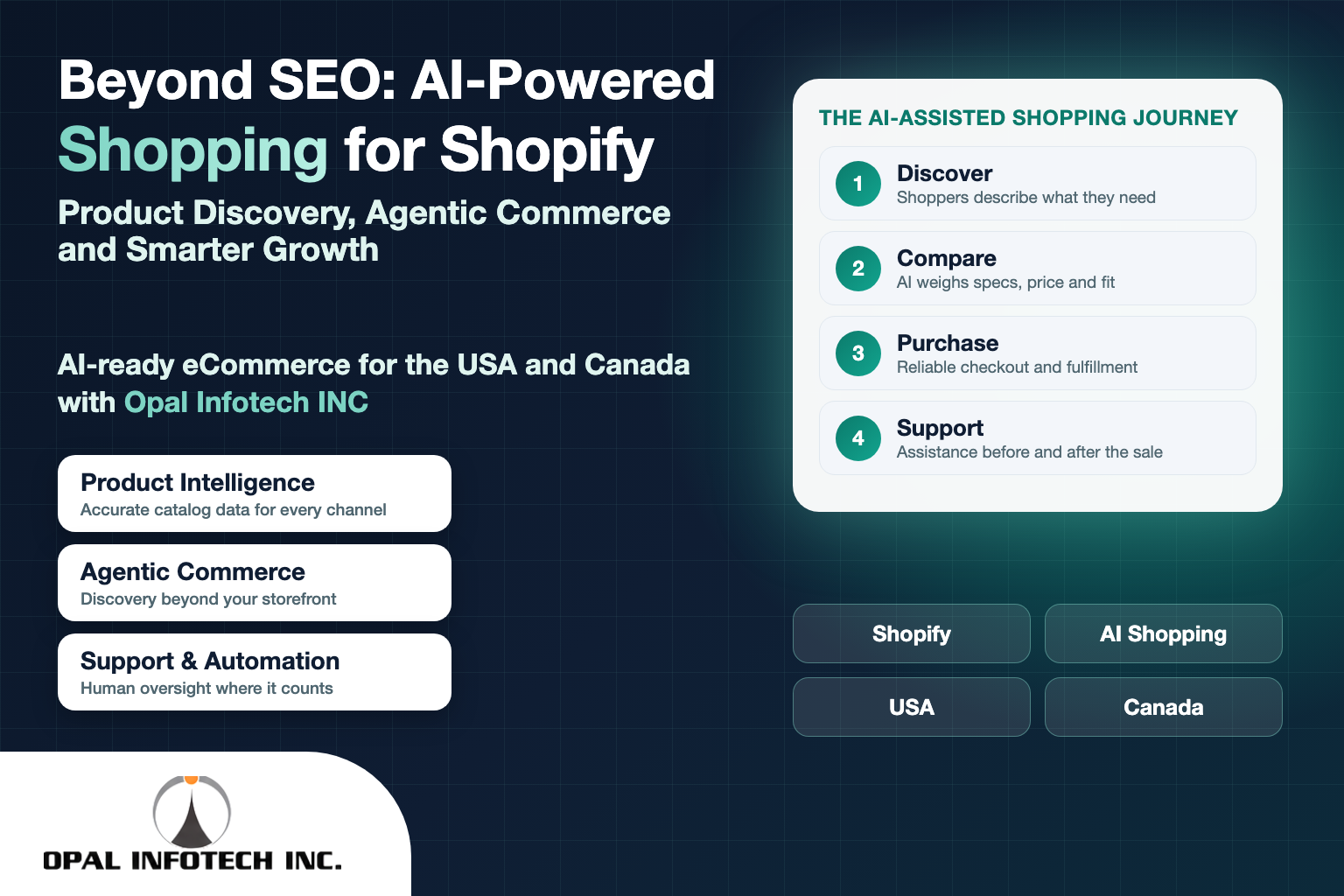
The eCommerce landscape across the United States and Canada is entering a new phase. Businesses that once relied primarily on search rankings, paid advertising and conventional online shopping experiences are now encountering customers who use artificial intelligence to research products, compare alternatives and simplify purchasing decisions.
Modern consumers increasingly expect digital shopping experiences that understand their preferences, answer specific questions and help them identify suitable products without unnecessary effort. This evolving behavior is encouraging retailers to reconsider how their online stores, product information, marketing systems and customer service operations work together.
For Shopify merchants, the opportunity extends far beyond gaining additional website traffic. AI-powered commerce can influence how shoppers discover products, how businesses manage catalogs, how customers make decisions and how retailers build relationships after the first purchase.
Shopify has also introduced agentic commerce capabilities that connect eligible merchants with AI-assisted shopping channels. These developments create opportunities for retailers to participate in purchasing journeys that may begin outside their traditional storefronts.
However, adopting AI does not automatically improve profitability. Businesses need reliable product data, suitable integrations, clear commercial priorities and strong customer experiences.
At Opal Infotech INC, we help eCommerce businesses connect technology, website development, digital marketing and automation with measurable commercial objectives. For Shopify brands operating in the USA and Canada, understanding the emerging AI commerce ecosystem is an important step toward building scalable digital operations.
Understanding the Shift From Conventional eCommerce to AI-Powered Commerce
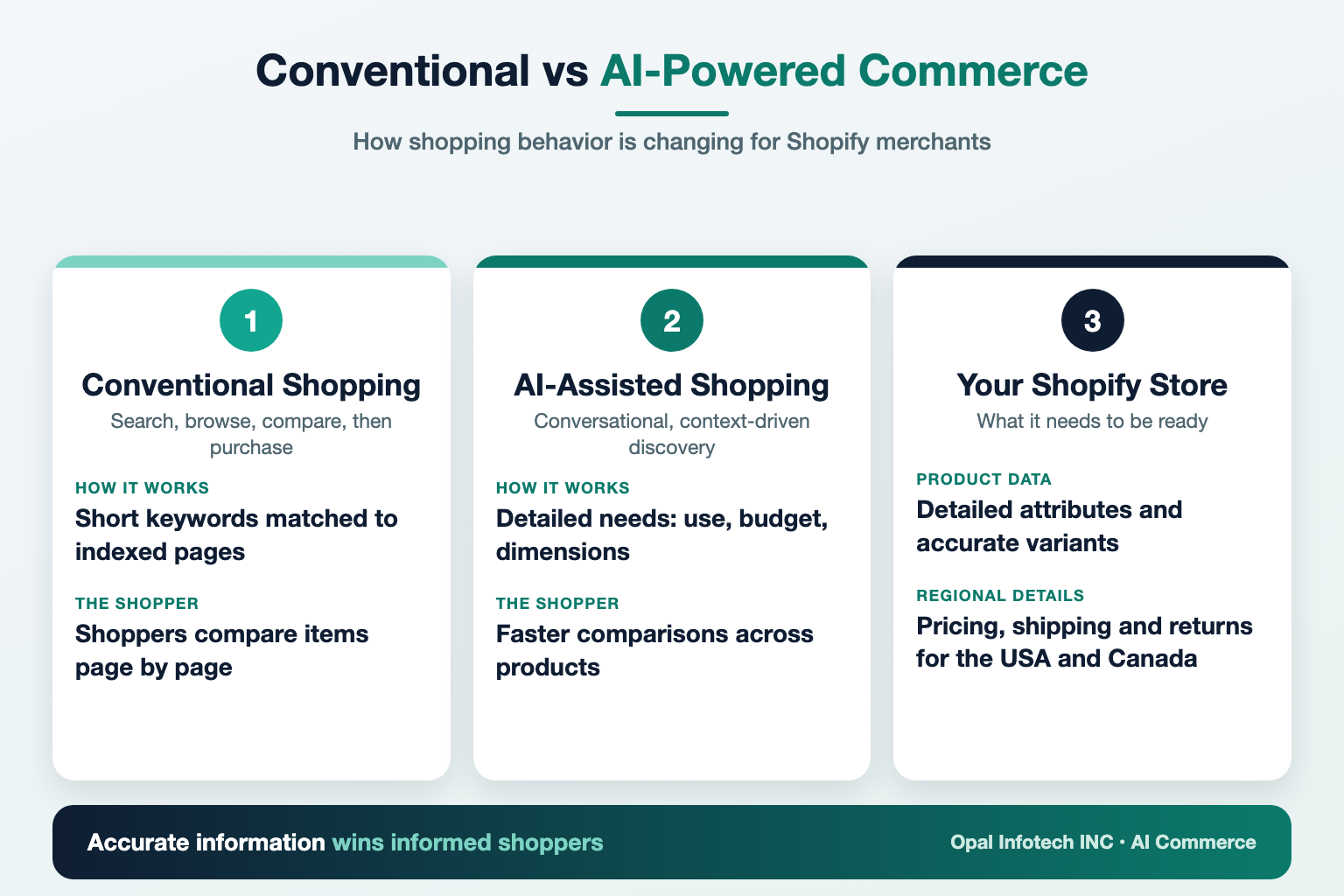
Traditional online shopping generally follows a familiar sequence. A customer searches for a product, browses results, visits a website, compares items and completes a purchase.
AI-powered commerce introduces a more conversational and context-driven approach.
Instead of entering a short keyword, a shopper might explain their requirements in detail.
Example: A Canadian customer might ask an AI assistant to help compare insulated winter jackets suitable for commuting in Toronto within a particular budget. An American customer could request recommendations for compact kitchen appliances that meet specific dimensions and performance requirements.
These interactions contain valuable context about intended use, pricing preferences and product characteristics.
Shopping Becomes More Intent-Focused
Conventional search systems largely respond to queries using indexed information and ranking systems. AI shopping assistants can additionally interpret conversational requirements and help users refine their preferences.
This shifts the emphasis from matching isolated keywords to providing detailed, accurate and contextually relevant product information.
What it means: For Shopify merchants, the practical implication is that product catalogs should clearly describe specifications, applications, variations and suitability.
Product Comparisons Become More Accessible
Customers may use AI tools to evaluate differences between products without examining numerous pages individually.
This can shorten certain research activities, although purchasing decisions still depend on trust, availability, delivery conditions and individual preferences.
Retailers that clearly communicate their product attributes are better positioned to support informed comparisons.
The Storefront Is No Longer the Only Starting Point
Customers may initially discover products through conventional search, social media, marketplaces, AI assistants or direct brand interactions.
Consequently, a successful commerce strategy must maintain accurate information and consistent customer experiences across multiple discovery environments.
The objective: Connect these interactions with dependable purchasing and fulfillment processes.
Why American and Canadian Shopify Brands Should Prepare for AI-Assisted Shopping
North American eCommerce businesses operate in competitive markets where customer expectations continue to evolve.
Retailers must compete not only on product availability and pricing, but also on convenience, relevance, reliability and service quality.
AI-assisted shopping adds another dimension to this competition.
Greater Demand for Personalized Shopping Assistance
Customers often want recommendations reflecting their individual needs rather than broad product collections.
Examples: A shopper purchasing skincare products might prioritize ingredient preferences, skin concerns and budget. Someone selecting home office equipment may consider workspace dimensions, connectivity and warranty coverage.
AI-enabled experiences can help customers narrow these choices when they are designed around reliable product information.
More Opportunities for Specialized Retailers
Large retailers may have extensive advertising resources, but specialized merchants can compete through product expertise and category knowledge.
Example: A niche outdoor equipment brand can provide detailed information about materials, seasonal suitability and intended applications.
This information can support product comparisons and help shoppers understand why particular items meet their requirements.
Regional Expectations Still Matter
American and Canadian shoppers may have different preferences relating to currency, shipping arrangements, delivery availability and customer support.
Retailers selling in both countries should account for regional pricing, applicable taxes, returns and cross-border purchasing conditions.
Key point: AI-assisted discovery becomes commercially useful only when the product recommendations are supported by accurate regional purchasing information.
Agentic Commerce: A New Direction for Shopify Retail Businesses
One of the most significant developments in modern eCommerce is the emergence of agentic commerce.
Agentic commerce refers to shopping experiences in which AI agents help consumers discover, evaluate and, where supported, purchase products through conversational interfaces.
Rather than functioning only as information tools, these systems may connect product research with transaction capabilities.
How Agentic Shopping Works
A customer describes a purchasing requirement to an AI assistant.
The assistant may access product catalog information, identify matching options and present relevant comparisons. Depending on the channel and merchant eligibility, the customer may then be able to proceed with a purchase through an integrated checkout experience.
Availability: Shopify's agentic storefronts support product discovery across participating AI platforms. Eligibility, channel support and direct-checkout availability vary.
What This Means for Shopify Merchants
Retailers must increasingly consider how their products are represented beyond their own online stores.
Accurate pricing, clearly identified variants, inventory availability and dependable product descriptions are important for AI-assisted commerce.
Poor-quality product information can result in confusing comparisons, unsuitable product matches or incorrect customer expectations.
Why Human Oversight Remains Essential
AI agents can simplify parts of the buying process, but merchants remain responsible for product accuracy, fulfillment and service commitments.
Companies should regularly review their commerce integrations and ensure that automated systems are using appropriate information.
Principle: AI-enabled selling should strengthen existing retail operations rather than introduce additional uncertainty.
Product Intelligence: Turning Shopify Catalog Data Into a Commercial Asset
Product information has traditionally been viewed as content required to populate an online store.
In AI-powered commerce, structured catalog information becomes a valuable operational resource.
Product intelligence involves organizing and maintaining data so that customers, internal systems and connected shopping platforms can understand what a business sells.
Create Detailed Product Attributes
Clothing retailer: May need to maintain accurate information regarding materials, sizes, fit, color options and care instructions.
Electronics seller: May require technical specifications, compatibility details, dimensions and supported accessories.
These attributes help customers make informed decisions and allow automated systems to distinguish between similar products.
Maintain Accurate Product Variants
Products with different sizes, colors or configurations should be organized logically.
If a customer selects a particular variation, the displayed availability and pricing should reflect that specific option.
Inconsistent variant information can complicate recommendations and purchasing workflows.
Connect Information Across Commerce Systems
Shopify Catalog provides a standardized product discovery layer for participating AI channels, while merchants can also use supported integrations and product feeds for other platforms.
Companies should review how updates to products, inventory and pricing are synchronized.
Strong catalog management improves operational consistency and provides a better foundation for future automation initiatives.
Personalization Without Creating Unnecessary Complexity
Personalization has become an important consideration in eCommerce because customers rarely share identical requirements.
However, meaningful personalization does not require displaying different content to every visitor.
It starts with identifying useful customer preferences and providing relevant shopping assistance.
Personalized Product Recommendations
Shopify retailers can use browsing context, product relationships and appropriate customer interaction data to suggest complementary items.
Example: An online furniture retailer could recommend compatible accessories or related furnishings based on the products a customer is exploring.
Suggestions should reflect genuine product relationships rather than indiscriminately promoting high-priced items.
Smarter Product Discovery
On-site search and filtering systems help customers narrow large catalogs.
Shopify provides built-in search functionality, and its Search & Discovery app offers options for managing filters and recommendations.
Retailers can evaluate which filters customers use and where search experiences fail to return useful products.
Balance Relevance With Privacy
Personalization should respect applicable privacy requirements and customer expectations.
Businesses must carefully consider what information they collect, why they collect it and how it is used.
Customer-focused approach: Emphasize useful shopping experiences without introducing intrusive or unnecessary data collection.
Improving Shopify Customer Support With AI Shopping Assistants
Customer support is an important part of online retail because shoppers often need assistance before and after making purchases.
AI-powered shopping assistants can help businesses respond to common questions and guide customers toward relevant information.
Support During Product Selection
A well-configured shopping assistant can explain product features, identify compatible items and guide customers toward suitable categories.
Example: A consumer electronics retailer might receive frequent questions about device compatibility, warranty conditions and product specifications.
An assistant connected to accurate product information can address routine inquiries while directing complex questions to qualified support representatives.
Improve Post-Purchase Communication
Customers frequently contact retailers about delivery progress, order modifications, return conditions and product instructions.
Where appropriate systems and permissions are available, automated support tools can retrieve relevant order information or guide customers through established procedures.
This can reduce repetitive support work and make customer service more accessible.
Know When Human Assistance Is Necessary
Not every customer issue should be handled automatically.
Payment disputes, unusual delivery problems, product defects and emotionally sensitive complaints may require human judgment.
Retailers should provide accessible escalation options and monitor the accuracy of automated responses.
Bottom line: Effective customer support combines convenient automation with accountability.
Conversion Optimization in the Age of AI-Assisted Product Discovery
Even when AI systems help shoppers identify relevant products, the purchasing experience remains crucial.
Retailers must ensure that visitors can understand product offerings, assess purchasing conditions and complete transactions without unnecessary friction.
Reduce Decision-Making Obstacles
Customers may leave a product page because they cannot confirm compatibility, identify the correct size or understand delivery restrictions.
Businesses should review product pages from the customer's perspective.
Important purchasing details should be accessible without forcing visitors to search through numerous unrelated sections.
Simplify Mobile Purchasing
Mobile shoppers often interact with product pages through smaller screens and touch-based navigation.
A mobile-friendly Shopify store should provide readable information, responsive controls, understandable checkout forms and appropriately sized product imagery.
Unnecessary pop-ups or complicated purchasing steps can interrupt the shopping process.
Test Conversion Improvements
Conversion rate optimization should rely on observed customer behavior rather than assumptions.
Businesses can evaluate product-page engagement, checkout progression, abandonment patterns and customer feedback.
Changes to page layouts, product information or checkout communication should be tested against relevant performance indicators.
Remember: AI-driven discovery may attract better-informed shoppers, but merchants still need reliable storefront experiences to turn interest into completed purchases.
Connecting AI Commerce With Shopify Inventory and Order Management
As an online business expands, operational coordination becomes increasingly important.
Retailers may manage hundreds or thousands of products across multiple locations, fulfillment partners and sales channels.
When product availability changes frequently, inaccurate information can create customer dissatisfaction.
Maintain Inventory Consistency
Inventory systems should reflect available quantities across relevant sales environments.
Example: A retailer selling through its Shopify website and additional channels needs a dependable method for managing stock updates.
Accurate information helps reduce the likelihood of customers ordering unavailable products.
Improve Order Processing
Automation can support routine activities such as order notifications, fulfillment status updates and internal task assignments.
Businesses may also integrate Shopify with inventory management, enterprise resource planning or shipping systems.
These integrations should be planned according to operational requirements and tested carefully before implementation.
Use Predictive Analysis Responsibly
Sales history, seasonal patterns and product demand information may support forecasting.
However, AI-generated forecasts are estimates rather than guarantees.
Retailers should consider supplier lead times, promotional activities, unusual demand changes and other relevant business factors before making inventory decisions.
Benefit: Better operational data can support more informed planning while reducing dependence on manual processes.
Ready to Make Your Shopify Store AI-Ready?
Opal Infotech INC helps Shopify brands connect product data, development, marketing and automation with measurable commercial objectives.
Talk to Opal Infotech INCBuilding a Unified Digital Marketing Strategy for Shopify Growth
AI-powered shopping introduces new discovery opportunities, but it does not eliminate the importance of established digital marketing channels.
Retailers should develop coordinated strategies that connect search visibility, advertising, content and customer communications.
Search Engine Optimization Still Matters
Traditional SEO helps customers discover product categories, shopping guides, brand information and relevant website pages.
Technical accessibility, useful content, appropriate internal linking and clear page organization remain important.
For brands targeting the USA and Canada, SEO strategies should also reflect relevant product terminology and regional requirements.
Paid Advertising Supports Targeted Acquisition
Google Shopping, search advertising and other relevant paid channels can help businesses reach customers with defined purchasing interests.
Campaigns should be organized around commercial priorities, product margins and available inventory.
Advertising performance should be evaluated through meaningful business outcomes rather than clicks alone.
Content Marketing Builds Product Understanding
Product comparisons, buying guides, demonstrations and practical educational content help consumers understand their options.
Example: A home improvement retailer could publish guides explaining how to choose products for particular installation conditions.
Well-developed content supports organic discovery while improving the information available to customers during their research.
Email Marketing Encourages Continued Engagement
Permission-based email campaigns can introduce new collections, communicate relevant updates and support repeat purchasing.
Segmentation allows retailers to deliver information that reflects customer interests or previous transactions.
An effective strategy avoids excessive promotional messaging and prioritizes relevance, consent and customer value.
The Importance of Customer Trust in AI-Driven eCommerce
Artificial intelligence may influence product discovery, but customer trust remains a fundamental requirement for successful online selling.
Buyers still need confidence in product quality, payment security, fulfillment and customer support.
Provide Transparent Business Information
Retailers should clearly identify their company, contact methods and applicable purchasing policies.
Customers need accessible explanations of delivery timelines, return conditions and warranty arrangements.
This information should remain consistent wherever the business presents its products.
Encourage Authentic Customer Feedback
Verified customer reviews can help prospective buyers understand real product experiences.
However, businesses should avoid fabricated testimonials, misleading review practices or unsupported product claims.
Authentic feedback provides valuable information for both prospective customers and internal product improvement.
Protect Customer Information
Shopify businesses must consider data security, access management and relevant privacy obligations.
Appropriate practices include limiting unnecessary access to sensitive information, maintaining secure integrations and reviewing third-party application permissions.
Responsible data handling is particularly important when introducing AI systems that process customer information.
Build Long-Term Brand Credibility
Customers evaluate reliability through repeated interactions.
Accurate descriptions, consistent product quality, responsive communication and dependable fulfillment contribute to a positive brand experience.
Key point: AI commerce may change how customers reach retailers, but it does not replace the importance of delivering what the business promises.
Adapting Shopify Commerce for the United States and Canada
Retailers operating across North America should develop customer experiences that reflect the requirements of each market.
A single Shopify store may serve both countries, but commercial operations should account for regional differences.
Currency and Pricing
American customers generally expect US-dollar pricing, while Canadian customers commonly prefer Canadian-dollar presentation.
Businesses should ensure that displayed pricing, checkout totals and supported payment options are communicated accurately.
Where multiple currencies are supported, retailers must review how conversion, settlement and pricing adjustments operate.
Shipping and Fulfillment
Delivery availability varies according to destination, fulfillment arrangements and product type.
A retailer shipping from the United States into Canada may need to consider customs documentation, import charges and delivery expectations.
Clear explanations help customers understand what to expect before purchasing.
Language and Localization
Canadian market strategies may require both English and French content depending on target audiences and applicable obligations.
Retailers focusing on Quebec should carefully review local language requirements.
Localization should extend beyond translation when product terminology, customer support or purchasing conditions differ.
Regional Shopping Preferences
Customers in different geographic markets may prioritize different product attributes.
Example: Seasonal apparel demand can vary considerably across American states and Canadian provinces.
Retailers can use relevant market data to guide merchandising, regional promotions and inventory planning.
Measuring the Commercial Impact of AI-Powered Shopify Initiatives
Businesses should establish measurable objectives before investing in AI-related tools.
Implementing new technology without evaluating its commercial contribution can increase complexity and operating costs.
Evaluate Product Discovery Performance
Retailers can examine how visitors find products, which categories receive engagement and where shopping journeys become unsuccessful.
AI referral traffic may be reported separately where available and technically identifiable.
However, some AI-assisted purchasing journeys may not appear as distinct referral sessions.
Monitor Conversion and Revenue Quality
Important indicators include purchase conversion rate, average order value, customer acquisition cost and contribution margin.
Retailers should also evaluate returns, refunds and support expenses.
A higher conversion rate does not necessarily translate into better profitability if acquisition or fulfillment costs increase.
Measure Support Efficiency
AI customer service tools can be evaluated using response accuracy, successful issue resolution, escalation frequency and customer satisfaction.
Simply counting automated responses does not establish that service quality has improved.
Review Automation Outcomes
Businesses should assess whether automation reduces manual effort, improves processing consistency or shortens relevant workflows.
These benefits should be compared against implementation costs, maintenance requirements and error risks.
Why measure: A measurement framework helps organizations determine which initiatives deserve further investment.
Common Mistakes Shopify Businesses Should Avoid When Adopting AI
AI commerce creates opportunities, but rushed implementation can result in unnecessary expenses and operational problems.
Mistake 1: One common mistake is adopting multiple AI applications without identifying specific business needs.
Every additional integration introduces considerations relating to cost, compatibility, data access and maintenance.
Mistake 2: Another mistake is relying on incomplete product information. An automated system cannot consistently provide accurate recommendations when the underlying catalog contains missing or contradictory details.
Mistake 3: Businesses should also avoid assuming that AI-generated marketing content is automatically accurate or suitable for publication.
Product descriptions, advertising claims and customer communications require appropriate review.
Mistake 4: A further risk involves neglecting the conventional shopping experience. Customers must still be able to navigate the store, evaluate products and purchase without using an AI assistant.
Mistake 5: Finally, merchants should not assume that participation in an AI commerce channel guarantees recommendations or sales.
Product eligibility, platform capabilities and customer demand all influence results.
A controlled implementation strategy allows businesses to introduce useful capabilities while maintaining dependable retail operations.
A 90-Day Roadmap for Building an AI-Ready Shopify Business
Shopify retailers can approach AI adoption through a structured implementation process.
The objective is to establish reliable foundations before introducing increasingly complex automation.
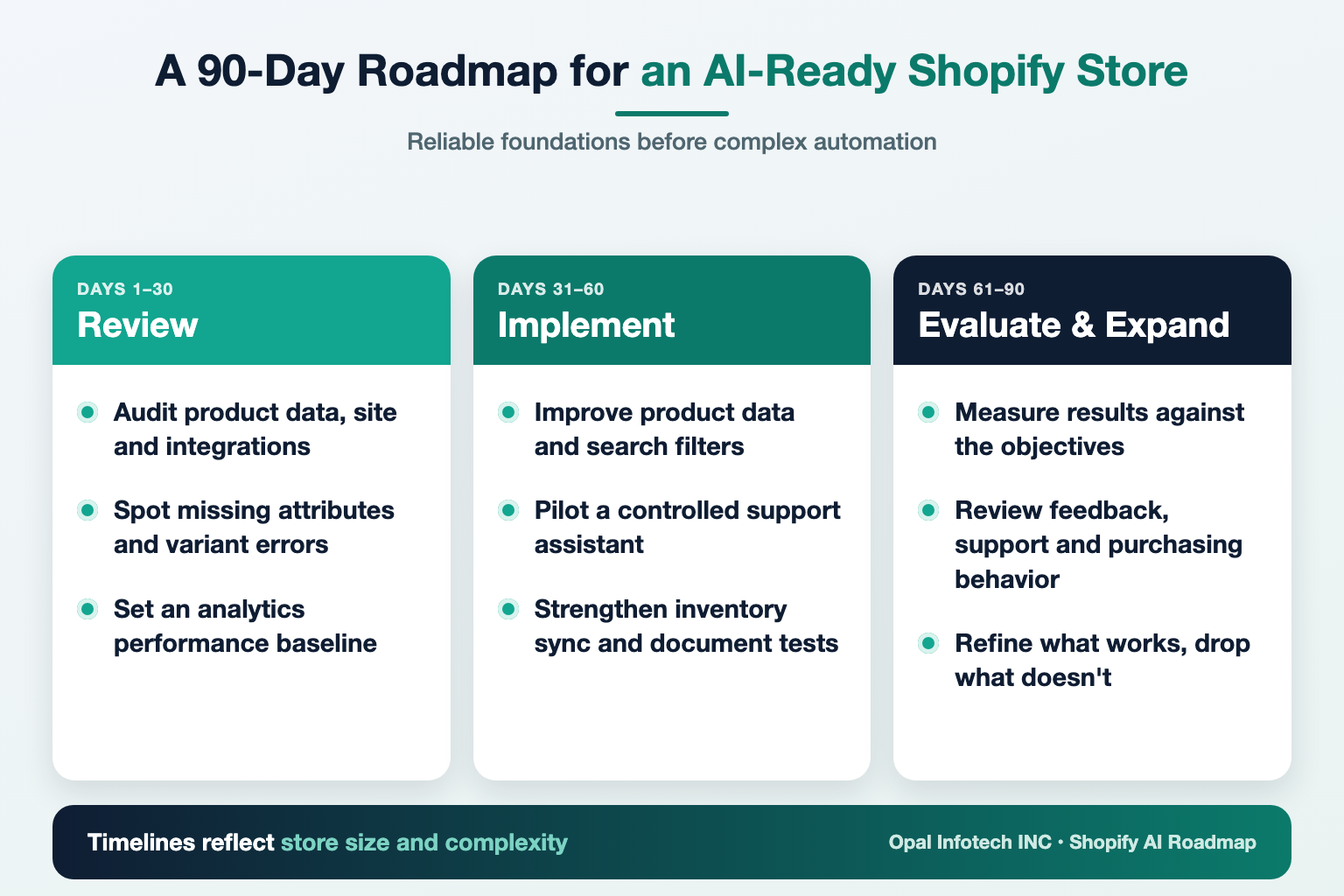
Days 1–30: Review Commerce Readiness
Begin with a detailed assessment of product information, website functionality and business integrations.
Identify missing product attributes, inaccurate variations, inconsistent shipping information and customer service challenges.
Review the existing analytics setup and establish a performance baseline.
Businesses should also examine which AI-related Shopify capabilities are available to their store and whether they align with commercial objectives.
Days 31–60: Implement Priority Improvements
Focus on initiatives that address established customer or operational problems.
These might include improving product data, configuring more relevant search filters, introducing a controlled support assistant or strengthening inventory synchronization.
Review permissions, integration requirements and customer-facing information.
Document testing procedures before releasing changes to live customers.
Days 61–90: Evaluate and Expand
Measure performance against the original objectives.
Review customer feedback, support outcomes, purchasing behavior and operational efficiency.
Refine successful initiatives and discontinue those that fail to provide sufficient value.
Set expectations: A 90-day roadmap offers a practical starting point, but implementation timelines should reflect business size, technical complexity and available resources.
How Opal Infotech INC Helps Shopify Brands Prepare for the Future of Commerce
Building an AI-ready eCommerce business requires more than installing applications or activating individual Shopify features.
Retailers must connect development, data management, marketing, customer experience and operational processes.
At Opal Infotech INC, we help organizations develop digital commerce strategies based on their commercial requirements and long-term business priorities.
Shopify Store Development and Customization
We help businesses plan and develop Shopify stores that reflect their products, customer requirements and operational objectives.
Our work can include storefront development, theme customization, functional enhancements and appropriate third-party integrations.
eCommerce SEO and Digital Marketing
We support online visibility through SEO, content optimization and digital advertising strategies.
Our objective is to connect relevant customer acquisition activities with meaningful shopping and business outcomes.
AI Integration and Business Automation
We help businesses identify practical opportunities for integrating AI-related capabilities and automation into suitable workflows.
These may include customer support, business process improvement and information management, depending on project requirements.
Performance Optimization and Analytics
We assist businesses in understanding their digital performance and identifying opportunities to improve customer experiences.
This includes evaluating the relationship between website functionality, marketing activities and commercial objectives.
Serving Businesses in the USA and Canada
We understand that North American eCommerce brands face varied challenges, including competitive customer acquisition, regional market expectations and evolving technology requirements.
Our approach emphasizes scalable solutions, practical implementation and alignment with business goals.
Rather than applying a single technology strategy to every store, we assess each organization's priorities and recommend appropriate development and digital growth initiatives.
Conclusion: The Future of Shopify Growth Is Intelligent, Connected and Customer-Focused
Artificial intelligence is influencing how consumers discover, compare and purchase products.
For Shopify businesses in the United States and Canada, these developments create opportunities to improve product discovery, support customer decisions and streamline selected retail operations.
However, sustainable growth depends on more than adopting the latest technology.
Reliable product information, transparent purchasing conditions, accessible customer support and coordinated marketing remain essential.
AI shopping assistants can help customers navigate complicated buying decisions. Agentic commerce can introduce additional shopping environments. Automation may reduce repetitive operational activities, while analytics can help businesses identify opportunities for improvement.
The strongest strategy connects these capabilities with the fundamentals of responsible eCommerce management.
Businesses should evaluate where AI can provide meaningful benefits, introduce technology through carefully planned initiatives and measure performance using commercially relevant indicators.
Opal Infotech INC helps businesses develop Shopify eCommerce experiences, digital marketing programs and technology solutions designed around evolving market requirements.
As AI-assisted shopping becomes more established, retailers that maintain accurate information, dependable operations and customer-focused experiences will be better prepared to adapt.
The future of commerce: The future of digital commerce is not simply about attracting more visitors. It is about creating connected shopping experiences that help customers make confident decisions while supporting sustainable business growth.
At Opal Infotech INC, we provide Shopify development, eCommerce SEO, digital marketing, AI integration and custom technology solutions for businesses targeting the USA and Canada. Connect with our team to discuss your Shopify development and digital growth requirements.
Prepare Your Shopify Store for the Next Generation of Digital Commerce
Whether you are launching a new Shopify store, expanding across North America or exploring AI-driven eCommerce capabilities, the right digital strategy can help align your technology with your business objectives.
Talk to Opal Infotech INC