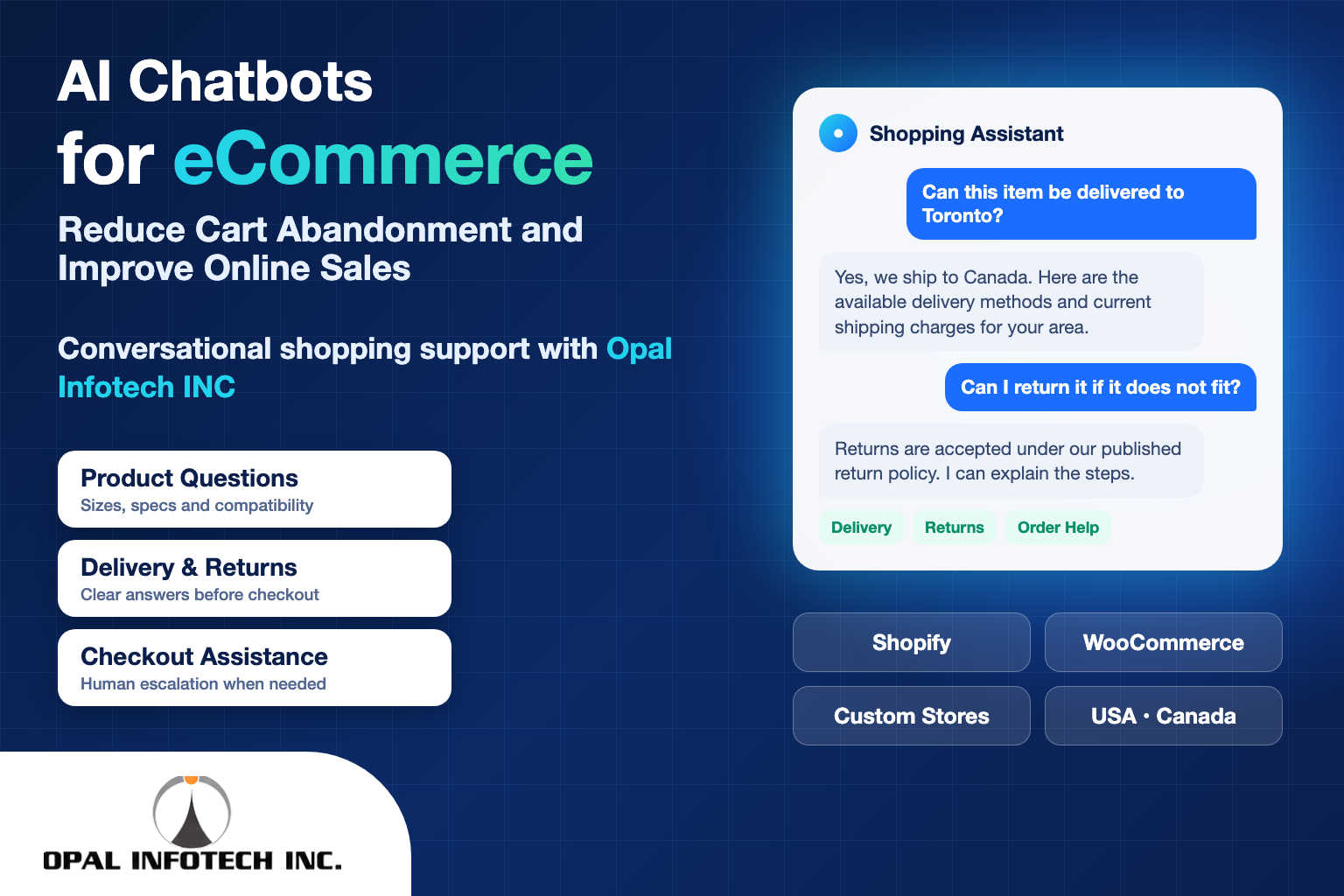
AI chatbots for eCommerce help online stores support customers throughout their purchasing journey. By answering product questions, explaining delivery options, clarifying return policies, and providing assistance during checkout, these tools can address issues that prevent shoppers from completing purchases.
For eCommerce businesses in the USA and Canada, AI chatbot integration creates opportunities to improve customer engagement, reduce avoidable cart abandonment, and increase online sales conversions. However, effective results depend on accurate information, appropriate chatbot placement, reliable website integration, and continuous performance evaluation.
Opal Infotech INC helps businesses explore AI chatbot solutions that connect customer assistance with their wider eCommerce website and digital growth objectives.
Introduction
Attracting visitors to an eCommerce website is only the beginning of an online sale. Customers must also find the right products, understand purchasing conditions, and feel comfortable completing their orders.
Even when buyers are interested in a product, unanswered questions can interrupt their purchasing decisions. They may need confirmation about product compatibility, delivery availability, payment methods, or return conditions before proceeding.
AI chatbots for eCommerce provide another way for online stores to address these questions without requiring customers to leave their current shopping experience.
For businesses looking to reduce cart abandonment, AI chatbot integration can support a broader eCommerce conversion optimization strategy. Instead of treating every abandoned cart as a lost sale, businesses can examine which questions remain unanswered and where additional customer support could improve the buying experience.
The opportunity extends beyond checkout. Conversational AI can help shoppers compare products, identify suitable options, and understand what they are purchasing.
This article examines how AI shopping assistants work, where they can help improve online store sales, what businesses should consider before implementation, and how to evaluate their contribution to conversion performance.
Why Online Shoppers Leave Before Completing Their Purchases
An abandoned shopping cart does not always indicate that a customer has rejected the product. Some visitors use carts to compare prices, calculate their expected order totals, or save products for future consideration. Others encounter questions that remain unresolved as they move closer to checkout.
Understanding these differences is important when developing a cart abandonment reduction strategy.
Customers Are Still Evaluating Their Purchase
Adding an item to a cart does not necessarily mean that a customer is ready to buy.
A shopper purchasing electronic equipment may need to verify compatibility with an existing device. Someone ordering clothing may want more information about sizing or fabric characteristics.
When essential details are difficult to locate, the customer may postpone the purchase rather than risk selecting an unsuitable product.
Delivery Conditions Affect Purchase Decisions
Shipping information can influence whether an online order is practical for the customer. Buyers may want to confirm:
• Whether delivery is available in their area
• The available shipping methods
• Estimated delivery dates
• Applicable shipping charges
• Whether order tracking is available
These questions may be especially relevant for stores serving customers across different states, provinces, and regions.
Return Policies Need to Be Understandable
Customers often review return conditions before purchasing unfamiliar products or buying from a store for the first time. Unclear information about return eligibility, exchange procedures, or refund processing can create uncertainty.
Even when a store offers an appropriate return policy, customers may struggle to understand it if the explanation is buried within lengthy legal or support documents.
Checkout Experience Creates Additional Friction
A complicated checkout process can interrupt an otherwise successful shopping journey. Account registration requirements, unclear form fields, unexpected charges, and payment failures are examples of issues that customers may encounter.
An AI chatbot cannot correct every technical or commercial problem. However, it can help explain certain requirements, direct customers toward available solutions, and escalate issues that need human attention.
What Is an AI Chatbot for eCommerce?
An AI chatbot for eCommerce is a conversational software application that helps customers access information and complete shopping-related tasks through natural language interactions. Rather than requiring visitors to navigate multiple website menus, a chatbot allows them to ask questions in everyday language. For example, a customer might ask:
“Do you have this product in a larger size?”
“Can this item be delivered to Toronto?”
“What is the difference between these two models?”
“Can I return the product if it does not fit?”
Depending on its configuration and connected information sources, the chatbot can provide relevant answers or direct the customer to an appropriate support resource. Unlike a basic decision-tree chatbot, an AI-powered assistant can interpret variations in how shoppers phrase their questions.
However, its responses are only as dependable as the information, business rules, and system connections supporting it.
For this reason, businesses should consider conversational AI as part of their eCommerce website operations rather than as an isolated messaging feature.
How AI Chatbots Help Customers Make Purchase Decisions
One of the most useful applications of conversational AI is supporting the decision-making process before the customer reaches checkout. Many online shoppers need more than a product image and a short description to make an informed purchase.
Product Discovery Based on Customer Requirements
A large product catalog can make it difficult for visitors to identify the right products. A conversational shopping assistant can ask questions about intended use, preferred features, product dimensions, or budget. The resulting conversation can narrow product choices according to the customer's stated requirements.
For example, a visitor looking for an office chair might specify an adjustable seat height, a particular material, and a price range. A chatbot connected to structured product information can use those requirements to identify relevant options.
This approach helps customers search by their actual needs rather than relying entirely on product categories and filters.
Product Comparison Through Conversation
Customers frequently evaluate several products before selecting one.
An AI assistant can explain documented differences in features, specifications, available options, and intended applications. A comparison may include:
Which product supports my requirements? Compare documented product specifications.
What sizes are available? Retrieve available size information.
How do these models differ? Explain relevant feature differences.
Is the item available? Check connected inventory information.
Does this product include a warranty? Explain published warranty conditions.
Responses should remain grounded in verified product data rather than unsupported recommendations.
Assistance for First-Time Buyers
New customers may be unfamiliar with an online store's ordering procedures. They may need explanations about account creation, guest checkout, promotional code usage, or payment options.
An AI chatbot can guide these customers toward the appropriate information without requiring them to contact support for every basic question.
This type of assistance can be especially relevant for businesses investing in SEO, Google Ads, social media campaigns, and other channels that introduce new visitors to their websites.
How AI Chatbots Can Reduce Cart Abandonment at Different Shopping Stages
Effective eCommerce chatbot integration is not limited to displaying a chat window on the payment screen. Different stages of the customer journey create different information requirements.
Businesses should determine where conversational support is genuinely useful rather than introducing unnecessary interruptions.
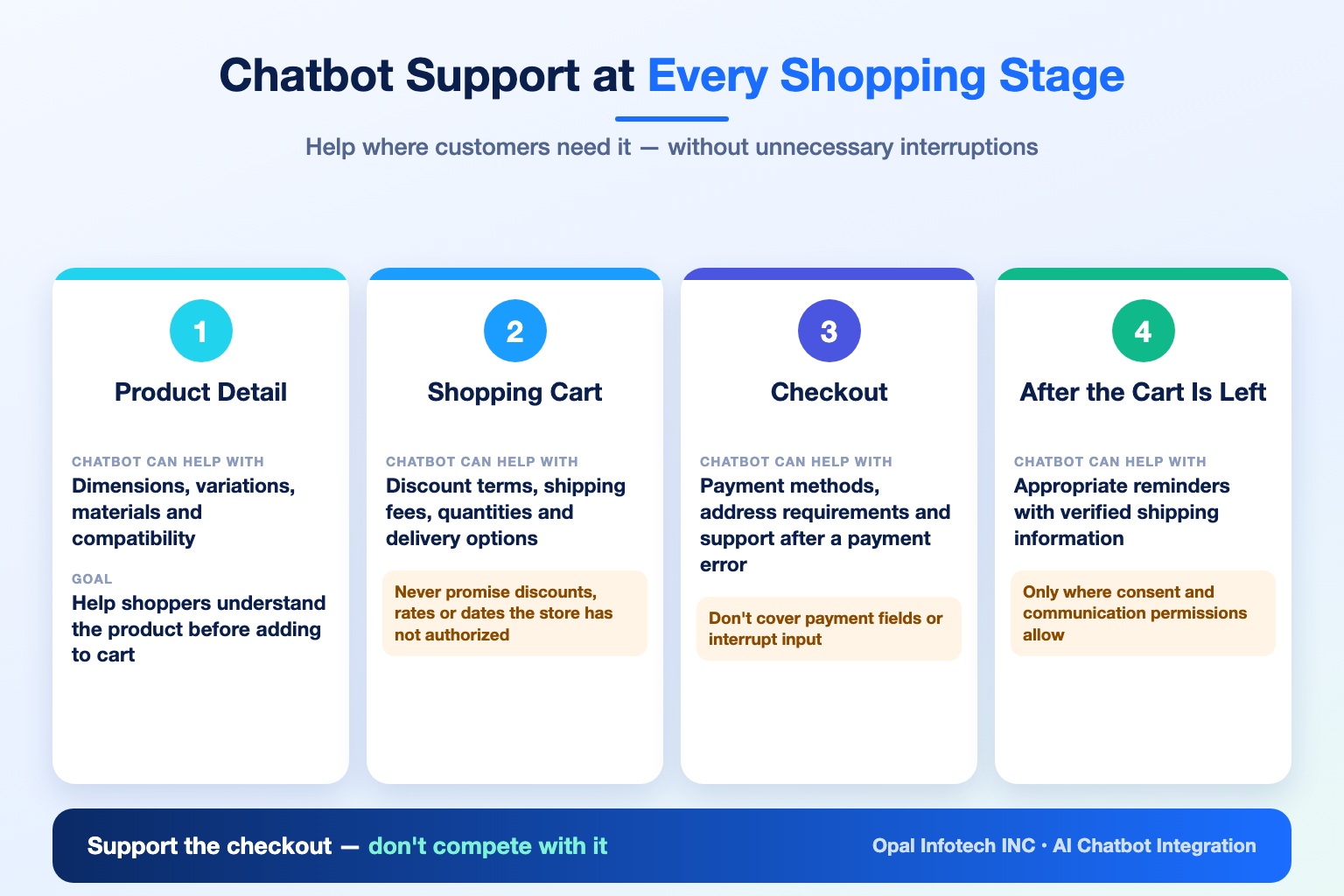
Product Detail Stage
At this stage, buyers are exploring whether a particular item meets their needs. A chatbot can provide information about:
• Product dimensions and specifications
• Available variations
• Material or component information
• Compatibility requirements
• Relevant usage instructions
The objective is to help shoppers understand the product before adding it to their carts.
Shopping Cart Stage
Once a customer has selected products, attention may shift toward order conditions. Questions about discounts, shipping fees, quantities, and delivery options can become more important. An AI shopping assistant connected to current store policies and relevant systems can explain the information available for the order.
For example, a chatbot may clarify how a published promotional offer applies or explain where shipping charges appear.
It should not promise discounts, shipping rates, or delivery dates that the store has not authorized.
Checkout Stage
During checkout, customers need concise answers without being distracted from completing the transaction. Useful assistance might include explaining accepted payment methods, helping customers understand an address requirement, or directing them to support following a payment error.
Chatbot interfaces should avoid covering payment fields, interrupting customer input, or requiring visitors to start unnecessary conversations.
The assistant should support the checkout process rather than compete with it for attention.
After a Customer Leaves the Cart
Some customers leave because they intend to return later. Where consent and communication permissions allow, businesses may use connected systems to send appropriate cart reminders or offer further assistance.
For example, a customer who previously asked about delivery may benefit from a follow-up containing verified shipping information. This requires careful management of communication preferences, privacy obligations, and messaging frequency.
An automated reminder should not assume that every abandoned cart represents an immediate sales opportunity.
The Role of Conversational AI in Personalized eCommerce Shopping
Personalization can make online shopping more relevant when it is based on information customers choose to share. Traditional eCommerce recommendations may rely primarily on browsing patterns, product categories, or previous purchases.
Conversational AI introduces another source of information: the customer's stated preferences. A shopper can describe exactly what they are looking for. For example: “I need a compact coffee machine for a small apartment, and I prefer something easy to clean.”
A chatbot with appropriate catalog information can use those preferences to identify suitable products and explain the differences. Personalization may involve:
• Recommendations based on stated product requirements
• Explanations matched to the customer's level of familiarity
• Relevant accessories when compatibility is established
• Assistance with navigating product variations
• Contextual answers based on the current product or cart
Businesses should avoid treating personalization as permission to collect unnecessary customer information. Where conversation history, account details, or behavioral data are used, privacy considerations and appropriate customer permissions should inform the implementation.
AI Chatbot Integration with eCommerce Platforms
A conversational interface becomes more useful when it can access reliable information from the systems operating the online store. However, adding AI capabilities requires more than connecting a language model to a website.
The chatbot must understand which information it can retrieve, which actions it is permitted to perform, and when it should transfer a conversation to a person.
Product catalog integration. Connecting a chatbot with structured product data enables responses about product names, descriptions, sizes, specifications, and variations. Catalog synchronization is important because product information changes over time. A chatbot relying on outdated records could recommend discontinued items or present incorrect product details.
Inventory integration. Inventory access can help answer questions about product availability. For example, a customer may ask whether a particular product variation is currently in stock. Where an authorized inventory connection exists, the chatbot can retrieve relevant availability information. Stock data should not be treated as a reservation or a promise that an item will remain available until checkout is completed.
Order management integration. After placing an order, customers may want assistance locating order status information. An authenticated chatbot can potentially help customers retrieve permitted order details. Access controls are essential. A conversational interface should not reveal personal or order information to an unauthorized visitor.
Human support integration. Not every conversation should be handled automatically. Questions involving unusual transactions, unresolved complaints, sensitive customer information, or exceptional commercial arrangements may require human review.
A well-planned support workflow defines when chatbot conversations should be transferred and what context support staff can access with appropriate permissions.
Choosing the Right AI Chatbot Features for an Online Store
Not every eCommerce business requires the same chatbot capabilities. A small catalog website may primarily need accurate product and policy answers. A larger retailer with multiple product categories may benefit from more extensive product discovery and system integrations.
The following capabilities can help businesses prioritize potential features, along with the main consideration for each:
Product and Search Capabilities
Product question answering: helps customers understand product details. Consider the accuracy of catalog information.
Conversational product search: guides shoppers toward relevant items. Consider product filtering and data quality.
Shipping and Cart Capabilities
Shipping information: clarifies delivery options. Consider current shipping rules.
Cart assistance: addresses ordering questions. Consider checkout interface usability.
Support and Analytics Capabilities
Order status support: responds to customer order inquiries. Consider authentication and privacy.
Human agent transfer: handles unresolved questions. Consider support availability and ownership.
Conversation Analytics
Conversation analytics: identifies recurring customer concerns. Consider responsible data collection.
The appropriate configuration depends on actual customer support requirements and the technical capabilities of the existing website.
How to Design an AI Chatbot That Supports Conversions Without Interrupting Customers
A chatbot that appears too frequently can become another source of friction. The design should reflect where customers need help and when they prefer to continue independently.
Make Assistance Easy to Find
A recognizable chat icon or assistance option allows customers to request help when necessary. Its placement should remain consistent across relevant pages.
On mobile devices, the interface should be checked carefully to prevent interference with navigation, cart controls, and checkout buttons.
Keep Answers Focused on the Question
A shopper asking about shipping should receive a direct explanation of shipping conditions. Lengthy promotional messages can make simple questions more difficult to resolve.
Responses should prioritize accuracy, clarity, and relevant next steps.
Avoid Unnecessary Sales Pressure
Conversational assistance should not pressure customers into completing purchases. Repeated discount prompts, artificial urgency, and excessive reminders can weaken customer confidence.
If a store has a legitimate offer, the chatbot may explain its terms. However, promotions should follow the retailer's approved rules.
Provide an Exit and Escalation Option
Customers should be able to close a chatbot conversation easily. When the assistant cannot answer a question confidently, it should communicate that limitation and offer an appropriate next step.
A clear route to human assistance can be more valuable than an automated response that sounds confident but contains incorrect information.
AI Chatbots for eCommerce Businesses in the USA and Canada
Online retailers operating in the United States and Canada may serve customers across different locations, currencies, delivery networks, and purchasing requirements.
An AI chatbot can help explain location-specific information when the relevant business rules and data are available.
Supporting Regional Shipping Questions
Customers may want to know whether a product can be shipped to their state or province. For stores serving both countries, cross-border ordering questions can involve shipping availability, customs-related charges, or specific delivery conditions.
The chatbot should explain only verified policies and direct customers to support when an order requires individual review.
Handling Currency and Pricing Questions
Businesses displaying prices in USD and CAD need consistent information across product listings, carts, and checkout. An AI assistant can explain the store's currency display and payment policies.
It should not independently calculate or guarantee exchange rates, taxes, or final charges when authoritative pricing information is unavailable.
Supporting Customers Outside Business Hours
Online purchasing does not always occur during a retailer's customer service hours. An AI chatbot can provide access to approved product and policy information at other times, subject to service availability.
For issues requiring human attention, the assistant can explain the relevant support process rather than implying that a representative is immediately available.
Planning AI Chatbot Integration for Your Store?
Opal Infotech INC can help assess your eCommerce platform, product information and customer support processes.
Talk to Opal Infotech INCHow to Measure the Impact of AI Chatbots on Online Store Sales
Introducing a chatbot is not enough to establish whether it improves business performance. Online retailers should identify measurable objectives before implementation and compare outcomes using reliable website and transaction data.
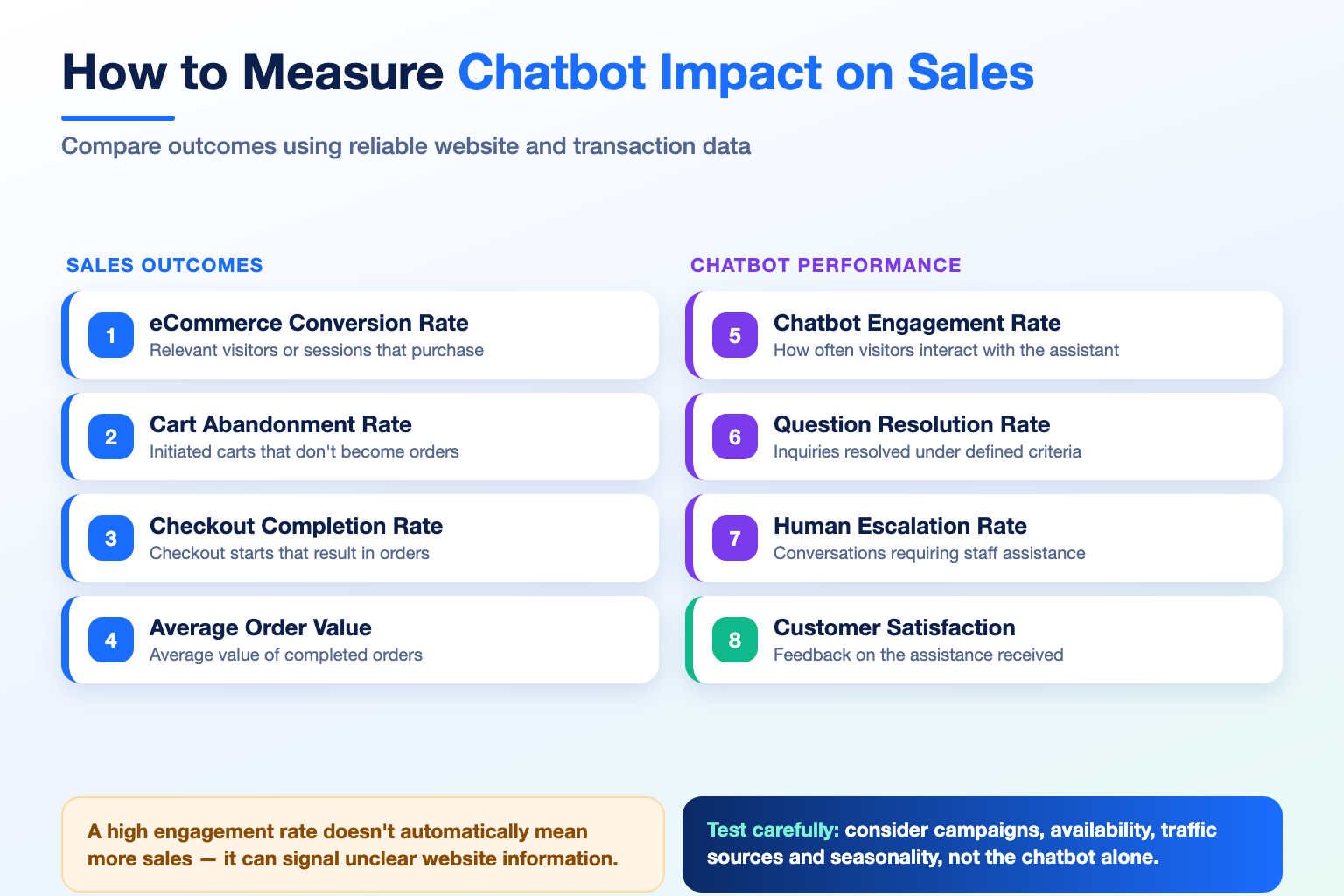
Key Performance Indicators
eCommerce conversion rate: percentage of relevant visitors or sessions resulting in purchases.
Cart abandonment rate: percentage of initiated carts that do not become completed orders.
Checkout completion rate: percentage of checkout starts that result in orders.
Chatbot engagement rate: how frequently visitors interact with the assistant.
Question resolution rate: share of chatbot inquiries resolved under defined criteria.
Human escalation rate: frequency of conversations requiring staff assistance.
Average order value: average monetary value of completed orders.
Customer satisfaction: customer feedback on the assistance received.
These measurements answer different questions. For example, a high chatbot engagement rate does not automatically indicate that the tool generates additional sales.
Some customers may use the chatbot because the website contains unclear information that should be improved directly.
Evaluate Conversion Performance Carefully
Businesses can compare customer journeys with and without chatbot access through appropriately designed experiments. Randomized testing can help distinguish genuine performance changes from differences in visitor intent or shopping behavior.
Other factors, such as promotional campaigns, product availability, traffic sources, and seasonal purchasing patterns, should also be considered.
The objective is to determine whether conversational assistance improves the buying experience and contributes to measurable commercial outcomes.
Common Mistakes to Avoid When Implementing eCommerce AI Chatbots
Conversational AI can create new problems when implementation focuses more on the technology than on customer requirements. Businesses should address several risks during planning and testing.
Providing information without verification: a chatbot should not invent product specifications, delivery commitments, or refund conditions.
Launching without defined responsibilities: someone must own the process of maintaining knowledge sources, reviewing responses, and managing unresolved inquiries.
Ignoring mobile usability: chatbot placement and behavior should be tested across common screen sizes and checkout workflows.
Collecting unnecessary personal information: conversations should request only the information necessary for their intended purpose, with suitable safeguards.
Treating every interaction as a sales opportunity: some customers need straightforward service rather than additional recommendations.
Skipping ongoing evaluation: product catalogs, store policies, and customer questions change. Chatbot quality should be reviewed accordingly.
Addressing these issues helps make conversational support more dependable for both customers and store operators.
A Practical Approach to AI Chatbot Implementation
Businesses considering an AI chatbot should begin by identifying customer problems rather than selecting features in isolation.
A practical implementation process can include the following stages.
1. Review the Existing Shopping Journey
Examine where customers ask questions, leave product pages, abandon carts, or request assistance.
Review available website analytics, customer service records, and feedback to identify recurring concerns.
2. Define the Chatbot's Responsibilities
Decide whether the initial chatbot will focus on product discovery, policy answers, cart assistance, or a combination of these activities.
Establish which tasks it may perform automatically and which require human approval or intervention.
3. Prepare Reliable Information Sources
Organize approved product content, policies, frequently asked questions, and system access requirements.
Define how information will remain current and how conflicting records will be handled.
4. Build and Test the Customer Experience
Develop conversation paths using realistic customer questions.
Test incorrect inputs, unclear requests, unavailable products, account access restrictions, and escalation conditions.
5. Monitor Results and Improve
After launch, review conversation quality, unresolved questions, customer feedback, and relevant eCommerce performance metrics.
Use these findings to improve both the chatbot and the underlying shopping experience.
How Opal Infotech INC Supports AI Chatbot Integration for eCommerce
Opal Infotech INC provides web development, eCommerce development, digital marketing, and AI-related services for businesses seeking to improve their online operations.
For online retailers in the USA and Canada, conversational AI initiatives should be aligned with the existing website, product information, customer service processes, and commercial objectives.
A suitable project begins by understanding how customers currently interact with the business and identifying where automated assistance could provide practical value.
The implementation scope depends on the eCommerce platform, available data, required integrations, customer privacy requirements, and the responsibilities assigned to the chatbot.
Opal Infotech INC can help businesses assess these requirements and plan AI chatbot integration as part of a wider website improvement and eCommerce conversion strategy.
Rather than assuming that AI alone will increase revenue, the focus should remain on making product information easier to access, reducing unnecessary purchasing difficulties, and creating a more useful customer experience.
Conclusion
Potential areas of implementation include conversational product support, shopping assistance, knowledge base integration, customer inquiry handling, and connections with existing business systems where technically appropriate.
Reducing cart abandonment requires businesses to understand why customers hesitate and what prevents them from completing purchases. AI chatbots offer a way to address certain information gaps through conversational product guidance, shopping assistance, and accessible customer support.
Their contribution to eCommerce sales depends on how effectively they connect with accurate business information, respect customer preferences, and fit within the purchasing journey.
For retailers in the USA and Canada, AI chatbot integration can be a valuable component of ongoing eCommerce website improvement when its objectives and results are clearly defined.
Frequently Asked Questions
What are the benefits of AI chatbots for eCommerce websites?
AI chatbots can help customers access product information, understand ordering conditions, compare suitable products, and find support during checkout. Opal Infotech INC helps businesses consider these capabilities within their eCommerce website requirements and customer service objectives.
How can AI chatbots reduce shopping cart abandonment?
AI chatbots may help reduce avoidable abandonment by answering questions about delivery, product compatibility, return conditions, and checkout procedures. Opal Infotech INC recommends evaluating these opportunities alongside usability improvements and accurate transaction data.
Can AI chatbots increase eCommerce conversion rates?
AI chatbots can contribute to a better purchasing experience by helping shoppers obtain relevant information. Whether they increase conversion rates depends on customer behavior, implementation quality, and other business factors. Opal Infotech INC encourages businesses to measure results rather than assume a specific increase.
Can AI chatbots be connected to Shopify or WooCommerce websites?
AI chatbot integration may be possible with Shopify, WooCommerce, and other eCommerce systems, depending on available interfaces, permissions, and technical requirements. Opal Infotech INC can assess the integration requirements for a particular website.
Can an AI chatbot provide personalized product recommendations?
Yes. When connected to suitable product information, an AI chatbot can help identify products based on customer preferences and documented specifications. Opal Infotech INC emphasizes using accurate catalog data and appropriate customer information practices for this type of implementation.
Do AI chatbots replace human customer service teams?
AI chatbots are useful for certain routine questions, but they do not eliminate the need for human support. Complex, sensitive, or unresolved issues may require staff involvement. Opal Infotech INC can help businesses define how automated assistance and human support should work together.
How much does AI chatbot integration cost for an eCommerce website?
Costs depend on the chatbot's functions, required integrations, website technology, information sources, and ongoing operational requirements. Opal Infotech INC can help review the proposed scope so businesses can request an appropriate project estimate.
How should businesses measure AI chatbot performance?
Businesses can evaluate response accuracy, question resolution, human escalation, customer feedback, and purchasing outcomes. Opal Infotech INC recommends monitoring these metrics alongside existing website analytics to understand the chatbot's contribution to business objectives.
Looking to improve customer engagement and checkout assistance on your eCommerce website?
Contact Opal Infotech INC to discuss AI chatbot integration, conversational shopping experiences, and website development requirements for your business.
Contact Opal Infotech INC