

For over two decades spanning the dynamic evolution of modern digital commerce, our team at Opal Infotech Inc., has navigated every major algorithm update, technological pivot, and paradigm shift in search. From the early days of basic directory listings and primitive keyword stuffing to the maturation of mobile-first indexing, semantic web mapping, and machine learning models, we have stood shoulder-to-shoulder with growing enterprises, local service providers, and multi-location brands across the United States and Canada. Yet, looking back across our 25 years of deep industry experience, we have never witnessed a transformation as profound, sudden, and structurally disruptive as the current revolution driven by conversational artificial intelligence.
For a generation, the unyielding law of online visibility was deceptively simple: secure a top-three blue clickable link on traditional search engine results pages (SERPs), and your business would capture a steady, predictable stream of qualified traffic. Business owners, marketing directors, and in-house growth teams in commercial powerhouses like New York, Los Angeles, Chicago, Houston, Dallas, Miami, and up north in Toronto and Vancouver invested billions into keyword research, backlink acquisition, and meta-tag optimization. Today, that foundation has shifted entirely beneath our feet, altering how human beings discover solutions forever.
Modern consumers, B2B procurement officers, and enterprise buyers increasingly bypass traditional search engines entirely. Instead, they turn directly to generative AI search engines and conversational answer engines such as ChatGPT, Google Gemini, and Perplexity. When a user asks these platforms a complex, nuanced question—such as, “What enterprise software provider in Chicago offers the best multi-cloud integration framework?” or “Who is the most trusted digital marketing agency for a multi-location retail chain in Toronto?”—the AI does not return a ten-blue-link directory. It instantly synthesizes billions of data points across the web and delivers a single, authoritative, definitive response, recommending specific businesses by name. If your brand is absent from these AI-generated answers, you are entirely invisible to high-intent buyers. This comprehensive guide explores how Generative Engine Optimization (GEO) works and how Opal Infotech Inc., positions your business to dominate this new era.
The Death of the Blue Link: Understanding the Paradigm Shift to AI Search
To appreciate why traditional marketing playbooks are rapidly losing efficacy, we must analyze how human search psychology and engine mechanics have fundamentally evolved over the past few years.
The Structural Limitations of the Index-and-Rank Model:
- Traditional search engines relied heavily on exact-string keyword matching, raw page authority scores, and sheer backlink volume.
- The burden of research fell squarely on the shoulders of the user, who had to open multiple browser tabs, compare disparate customer reviews, and piece together a purchasing decision manually.
- This friction created opportunities for low-quality sites to game rankings through keyword stuffing rather than true authority.
The Rise of the Conversational Consultant:
- Generative AI functions as an intelligent, conversational proxy that understands intent, sentiment, multi-layered context, and secondary parameters.
- Users receive synthesized, holistic answers instantly, drastically reducing the necessity to click through to standard, ad-heavy SERPs.
- The user gets an immediate verdict rather than a homework assignment.
The Winner-Take-All Market Dynamics:
- In traditional search, ranking #4 or #5 still yielded a respectable, profitable share of organic clicks.
- In conversational AI search, the underlying model typically recommends one to three elite solutions. If an algorithm deems your competitor more authoritative, your brand is entirely omitted from the conversation.
Over our 25 years in the digital trenches, we have seen channels rise and fall, but none have concentrated authority quite like generative AI. Adapting to this reality is no longer an optional luxury for forward-thinking enterprises in competitive hubs like Dallas or Miami; it is an absolute survival requirement.
How AI Search Engines Choose Which Businesses to Recommend?
A common misconception among executives is that AI search engines select featured brands randomly, through paid bidding, or via simple keyword frequency. In reality, large language models (LLMs) rely on rigorous, multi-layered evaluation protocols to verify credibility before citing a business.
Entity Recognition and Knowledge Graphs:
- AI models map your brand as a distinct "entity" across the web, evaluating your executive leadership, physical locations, service verticals, and historical footprint.
- If an AI cannot clearly isolate your brand identity from generic terms, it will omit you from consideration.
Cross-Platform Consensus and Digital Footprint:
- Algorithms cross-reference data from verified review platforms, industry directories, and authoritative trade publications to ensure your business is consistently well-reviewed.
- Discrepancies in your NAP (Name, Address, Phone) or conflicting service descriptions across third-party sites severely damage your AI citation score.
Contextual Clarity and Semantic Consistency:
- If your messaging varies wildly across your website, social media channels, and external press releases, AI crawlers grow confused and bypass your brand in favor of clearer competitors.
Structured Data Integrity:
- Machine-readable signals must explicitly communicate your operational hours, service areas, pricing tiers, and organizational credentials.
At Opal Infotech Inc., our quarter-century of expertise allows us to audit these signals comprehensively, ensuring that AI models across North America recognize your enterprise as an undisputed industry authority.
The Technical Foundation: Why Website Design Dictates AI Readability
Many businesses treat website design as a superficial exercise centered purely on flashy graphics, trendy color palettes, and cinematic animations. While visual appeal matters for human engagement, poor underlying architecture acts as a brick wall for AI search crawlers.
The Mechanics of AI Crawling:
- AI bots parse underlying code, hierarchical HTML heading structures, and text-to-code ratios rather than appreciating aesthetic flair.
- Bloated codebases, heavy unoptimized scripts, and broken site architecture cause AI parsers to abandon your pages prematurely before indexing your value proposition.
Core Pillars of AI-Ready Website Design:

Logical Content Hierarchy:
Clean utilization of H1, H2, and H3 tags that outline topic relationships clearly for machine learning models.

Exceptional Core Web Vitals:
Lightning-fast server response times and efficient rendering ensure bots can ingest hundreds of pages instantly without timeout errors.

Mobile-First Accessibility:
Given that a vast majority of voice-based and mobile AI queries originate on-the-go in bustling markets like New York and Vancouver, responsive design is mandatory.

Structured Schema Markup:
Advanced JSON-LD data layers explicitly spelling out your business offerings, FAQ schemas, and organizational entity data to automated crawlers.
Our web engineering teams design high-performance, conversion-optimized digital platforms that satisfy both human buyers and rigorous machine learning indexing standards.
Result-Driven AI SEO: Moving Beyond Traditional Keywords
Traditional Search Engine Optimization focused heavily on exact-match keyword density—repeating phrases like “best software developer in Houston” dozens of times across a page. Generative Engine Optimization (GEO) operates on an entirely different level.
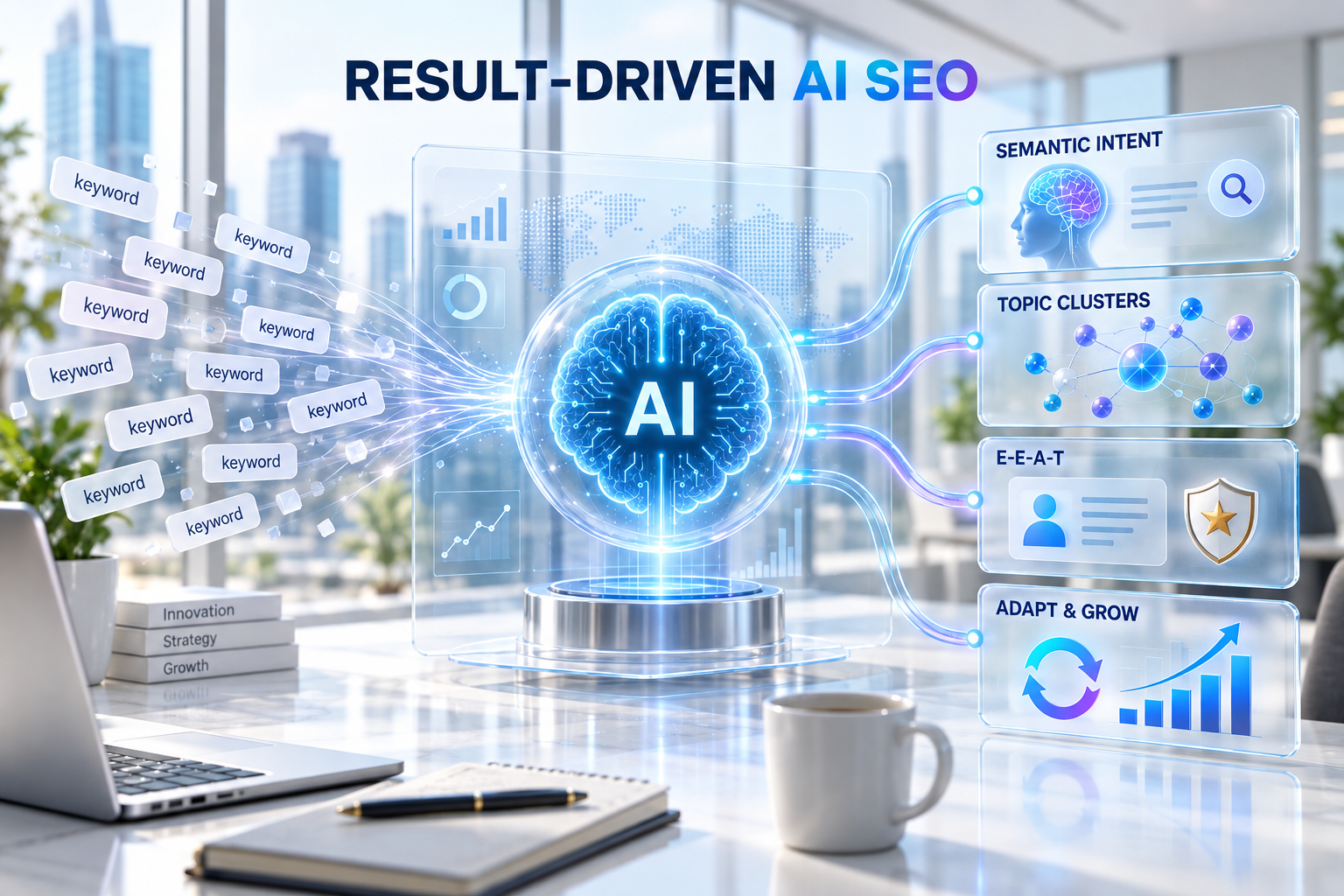
Semantic Search and Intent Mapping:
- AI search engines process natural, conversational queries that mimic human dialogue.
- Content must address the underlying intent, sub-questions, and contextual nuances of your target buyers rather than just matching a 3-word phrase.
Comprehensive Topic Clusters:
- Instead of optimizing isolated web pages for single keywords, brands must establish deep, authoritative subject matter authority across entire knowledge domains.
- Building interconnected resource hubs signals to AI models that your site is a definitive source of truth.
E-E-A-T (Experience, Expertise, Authoritativeness, and Trustworthiness):
- AI models actively seek out first-person professional insights, verified case studies, and expert citations. Because our team brings 25 years of proven digital mastery, we bake authentic industry expertise directly into every strategy we deploy.
Continuous Algorithmic Adaptation:
- As models like ChatGPT, Gemini, and Perplexity update their ingestion weights, our ongoing AI SEO campaigns adapt your digital assets to maintain front-and-center visibility.
Real Feedback, Real Results
“We have had the pleasure to work with Opal for many years. Very responsive staff, quick support, best service ever”
- quikoitaly
Crafting Content That AI Loves and Humans Convert On
Writing for generative search engines does not mean sacrificing human readability; in fact, the exact opposite is true. Because AI engines strive to deliver the most helpful, digestible answers to human users, content that excels in AI search is exceptionally clear, structured, and friction-free.
The Clarity Imperative:
- Avoiding dense, overly complicated corporate jargon that confuses both human readers and AI text summarizers.
- Presenting clear, direct definitions of your core services within the first few sentences of every page.
Scannability and Information Architecture:

Clear Headings:
Guiding the reader and the bot logically from broad concepts to granular details.

Bullet Points & Numbered Lists:
Breaking down complex multi-step processes so AI models can easily extract precise snippets to form direct answers.

Frictionless Call-to-Actions (CTAs):
Ensuring that once an AI search user lands on your site, they face an unmistakable, compelling path toward conversion.
Frequently Asked Questions (FAQs)
What is the core difference between traditional SEO and AI search optimization?
Traditional SEO optimizes your site to rank among a list of ten blue links on a search engine results page. AI search optimization (GEO) restructures your content and technical authority so conversational models like ChatGPT, Gemini, and Perplexity synthesize your data and recommend your business directly by name.
Why is my business website receiving visitor traffic, but failing to generate quality leads?
Traffic volume alone does not drive revenue. Low conversion rates typically stem from unclear above-the-fold messaging, weak or hidden calls to action, sub-optimal mobile UX, or a lack of robust digital trust signals (such as case studies and verified client testimonials).
How does Opal Infotech Inc. integrate AI SEO into existing marketing budgets?
We perform a comprehensive audit of your current digital footprint, identifying technical gaps in your schema markup, restructuring your content hubs for semantic relevance, and aligning your paid and organic channels into a unified, high-ROI growth engine.
Are these AI search strategies effective for local businesses in cities like Los Angeles or Toronto?
Absolutely. Local AI queries (e.g., “Find an emergency commercial plumber near me with top ratings”) rely heavily on hyper-local schema, consistent directory citations, and structured service area data, which our local SEO frameworks target directly.
How long does it take to see tangible results from Generative Engine Optimization?
While timelines vary based on industry competitiveness and current domain authority, foundational technical fixes and schema deployments can be indexed rapidly, with sustained AI recommendation visibility building over 3 to 6 months of consistent optimization.
Conclusion & Comprehensive Service Ecosystem
The digital marketing landscape is undergoing its most revolutionary transformation since the dawn of the internet. As conversational AI platforms like ChatGPT, Gemini, and Perplexity rapidly reshape how consumers and enterprise buyers discover products and services, organizations that fail to evolve risk slipping into total digital obscurity. Securing your brand’s future requires an experienced, forward-thinking partner who understands both the technical intricacies of machine learning algorithms and the timeless principles of high-converting marketing.
For 25 years, Opal Infotech Inc., has stood as a trusted beacon of digital excellence for businesses across the United States and Canada—spanning dynamic metropolitan hubs from New York, Los Angeles, Chicago, Houston, Dallas, and Miami to Toronto and Vancouver. We invite you to future-proof your enterprise today. Beyond our cutting-edge AI SEO and Generative Engine Optimization strategies, Opal Infotech Inc., delivers a comprehensive, full-spectrum digital ecosystem designed to scale your revenue, including:

Digital Marketing:
Incorporating advanced AI SEO, content syndication, and multi-channel authority building.

Paid Advertising & Traditional SEO:
Expertly managed Google Ads (PPC) campaigns paired with robust organic search optimization for immediate and long-term customer acquisition.

Custom Website Design and Development:
Crafting lightning-fast, visually stunning, and AI-readable digital experiences.

Mobile App Development:
Building scalable, feature-rich iOS and Android applications engineered for superior user engagement.