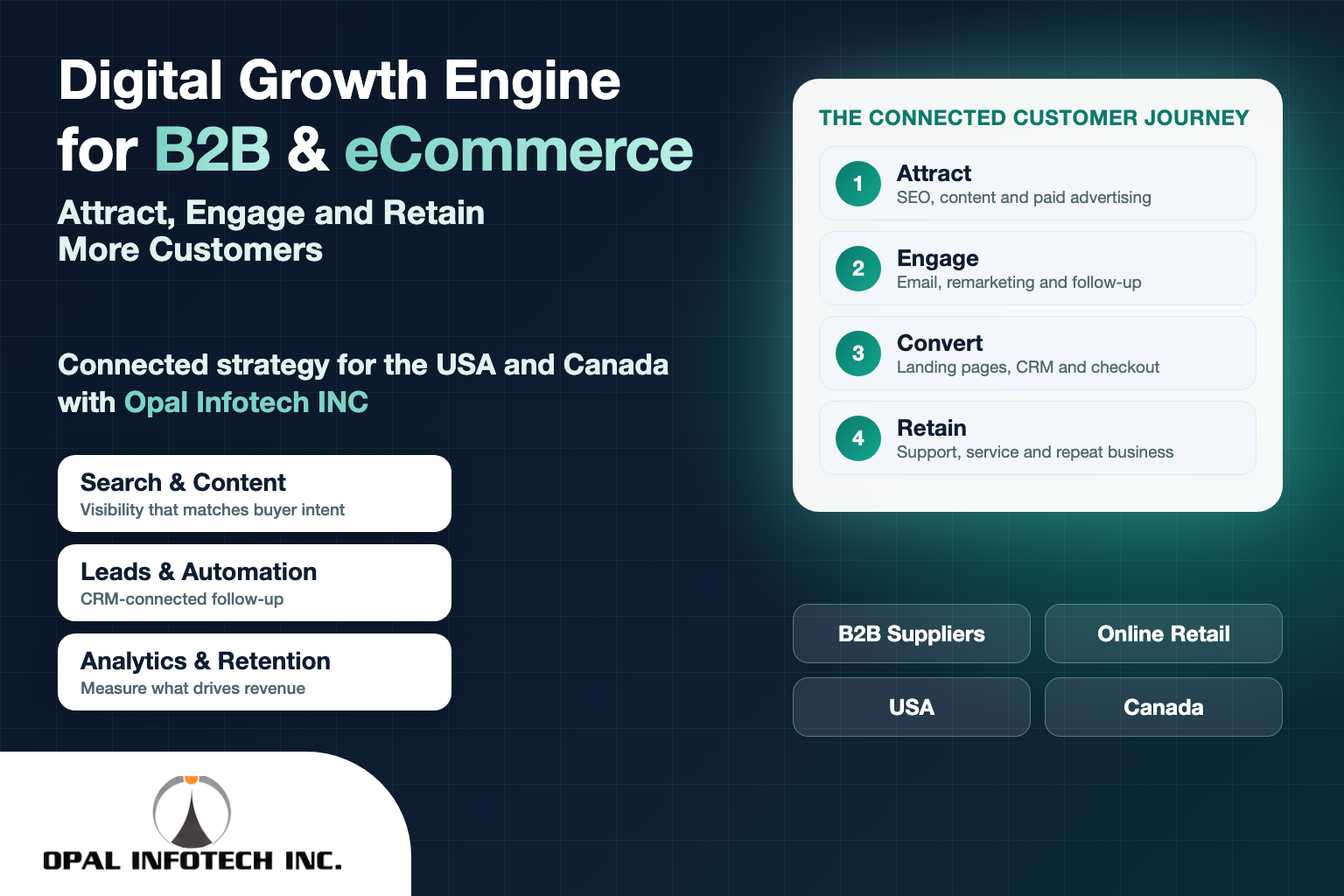
The digital marketplace in the United States and Canada offers enormous opportunities for B2B enterprises and eCommerce businesses. However, expanding online visibility alone is no longer enough to generate sustainable business growth. Companies must connect their marketing activities, sales processes, customer experiences and technology platforms into a coordinated strategy.
Modern buyers frequently compare multiple suppliers, evaluate product information, investigate company credibility and explore alternatives before making purchasing decisions. Whether a manufacturer is targeting procurement managers or an online retailer is reaching individual consumers, the ability to provide relevant information throughout the buying journey has become increasingly important.
A successful digital growth strategy therefore extends beyond attracting visitors. It involves identifying valuable audiences, developing meaningful engagement opportunities, nurturing prospective customers and encouraging repeat business.
For organizations operating across North America, additional considerations include regional competition, localized customer expectations, mobile shopping behavior and differences between business purchasing processes.
At Opal Infotech INC, we help companies connect digital marketing, web development, search visibility and technology solutions with practical commercial objectives. Our approach focuses on building a coordinated digital ecosystem that supports customer acquisition, operational efficiency and long-term business development.
Understanding the Digital Growth Opportunities in the USA and Canada
The United States and Canada represent diverse commercial markets with established digital purchasing habits and significant opportunities across industrial, wholesale, service and retail sectors.
However, companies entering or expanding within these markets must recognize that customer expectations differ across industries, geographic locations and purchasing models.
Digital Opportunities for B2B Companies
B2B purchasing generally involves detailed research, technical evaluation and communication among several stakeholders. Manufacturers, importers, distributors and industrial suppliers must often address questions concerning product specifications, compliance, availability, delivery arrangements and after-sales support.
A strong digital presence helps businesses communicate these details before direct conversations begin.
Example: An industrial equipment manufacturer targeting American procurement teams can develop detailed application pages, downloadable specifications and industry-specific content. These resources help prospective customers assess suitability before contacting the sales department.
Similarly, a Canadian wholesale supplier can create dedicated content for different industries, improving the relevance of its digital outreach.
Digital Opportunities for eCommerce Businesses
Online retail introduces different challenges. Customers typically expect transparent product information, convenient purchasing options, reliable fulfillment details and responsive customer support.
Successful eCommerce growth strategies must account for customer acquisition costs, average order values, product profitability and repeat purchase opportunities.
Cross-border selling: Businesses selling across the US–Canada border should also consider currency presentation, shipping arrangements, applicable taxes, returns and potential customs requirements. A regional strategy allows companies to communicate more effectively with buyers while avoiding unnecessary complications during the purchasing process.
Creating a Connected Digital Customer Acquisition Strategy
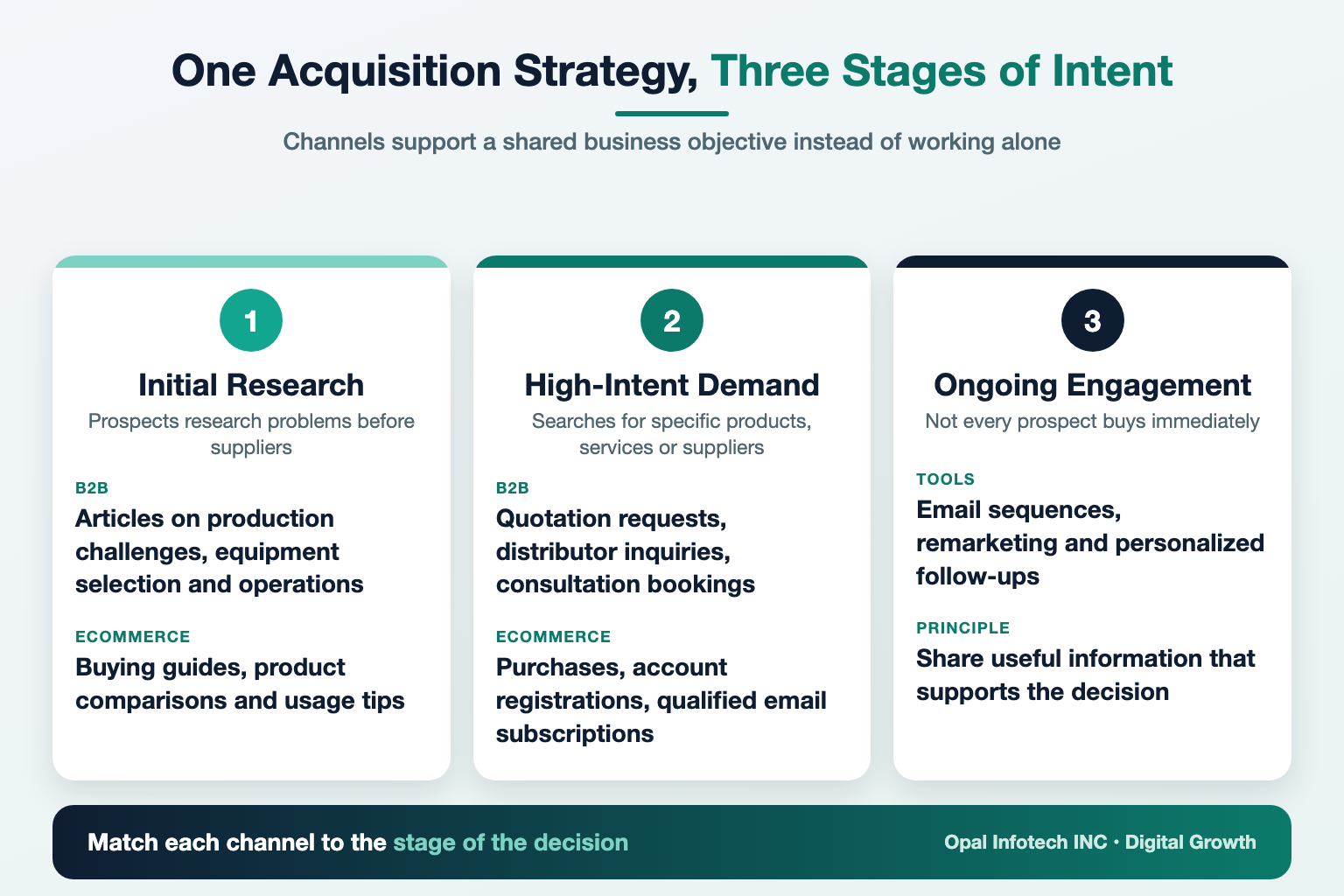
Customer acquisition becomes more effective when different marketing channels support a shared business objective rather than operating independently.
A company may invest in organic search, Google Ads, email campaigns and social media advertising. However, without consistent messaging and customer data, these activities can produce disconnected experiences. An integrated approach aligns channels with different stages of customer decision-making.
Reaching Prospects During Initial Research
Potential customers often begin by researching problems rather than searching directly for suppliers.
A manufacturing company might attract prospects through educational articles explaining production challenges, equipment selection or operational improvements. An eCommerce brand could publish buying guides, product comparisons and practical usage recommendations.
This content introduces the business to prospective customers before they have finalized their purchasing preferences.
Capturing High-Intent Demand
Customers searching for specific products, professional services or suppliers may be closer to taking action. Search engine optimization and targeted advertising can help businesses reach these audiences when their requirements are clearly defined.
Effective campaigns connect search intent with relevant landing pages, appropriate calls to action and measurable conversion events.
The valuable actions differ by business model:
For B2B organizations, valuable actions may include quotation requests, distributor inquiries or consultation bookings.
For eCommerce brands, these actions commonly include product purchases, account registrations and qualified email subscriptions.
Maintaining Engagement After Initial Contact
Not every prospective customer purchases immediately. Email sequences, remarketing campaigns and personalized follow-ups can help businesses maintain meaningful communication during longer purchasing cycles.
The objective is to provide useful information that supports decision-making instead of repeatedly presenting generic promotional messages.
Key principle: Match every channel to the stage of the buying decision, so each touchpoint adds value rather than noise.
Using Search Engine Optimization to Build Sustainable Market Visibility
SEO remains an important component of digital customer acquisition because it helps businesses reach audiences actively searching for relevant information, solutions and products.
However, effective SEO requires more than placing popular keywords within website content. Companies must align search visibility with customer intent, content quality, technical accessibility and measurable commercial outcomes.
Building Industry-Specific Keyword Strategies
B2B companies should identify keywords that reflect their products, applications and target industries.
For example, a packaging machinery supplier may target searches related to automated packaging equipment, production capacity, specific machinery types and regional supplier availability.
Specific beats broad: A broad keyword might attract general interest, while a specialized application keyword could reach a smaller but more commercially relevant audience.
eCommerce businesses should organize keywords around product categories, product attributes, customer requirements and purchase-related searches.
Developing Content Around Customer Questions
Customers frequently require answers before selecting products or suppliers. An effective content strategy may include technical explainers, industry guides, comparison articles, product applications and troubleshooting resources.
Each article should address a distinct question and provide information that genuinely helps readers evaluate available options.
For Canadian and American audiences, companies can also develop regionally relevant pages where their offerings, services or market conditions genuinely differ.
Strengthening Technical Search Performance
Search engines need to access, interpret and index website content effectively. Businesses should maintain logical navigation, appropriate canonical tags, relevant internal links, crawlable product information and accessible page structures.
Technical audits can identify duplicate content, broken links, indexing issues and unnecessary page-loading delays.
Why it matters: These improvements support a reliable foundation for ongoing SEO investment.
Preparing Business Content for AI-Powered Search Discovery
AI-assisted research is changing how prospective customers explore products, compare suppliers and understand complex business requirements.
Instead of relying exclusively on conventional search results, some buyers now use conversational search tools to investigate potential solutions.
This creates another reason for businesses to prioritize accurate, well-organized and helpful information.
Creating Content That Answers Specific Questions
Content should clearly explain what a product or service does, who it serves, where it is available and how it addresses customer requirements.
Industrial businesses can provide specifications, applications, compatibility information and practical selection guidance.
Online retailers can include product dimensions, materials, usage instructions, shipping policies and comparison details.
Result: These elements help readers and automated systems interpret the information more effectively.
Demonstrating Credibility Through Evidence
Original expertise contributes significantly to content quality. Businesses can strengthen their information with documented examples, clearly attributed technical claims, product documentation, author credentials and verifiable company details.
Case studies should describe the challenge, implementation and results wherever reliable evidence is available.
Although no content format guarantees inclusion in AI-generated answers, transparent and consistently structured information makes digital resources more useful and easier to interpret.
Maintaining Consistent Business Information
Company names, contact details, service descriptions and regional availability should remain consistent across relevant digital properties.
Structured data can also communicate supported information about an organization, its products and its content to search engines.
Remember: Businesses should treat AI search readiness as an extension of strong SEO and content practices rather than an isolated ranking shortcut.
How B2B Businesses Can Generate More Qualified Sales Opportunities
For many B2B businesses, the biggest marketing challenge is not necessarily generating more inquiries. It is attracting prospects whose requirements match the company's products, capabilities and commercial priorities.
A high volume of irrelevant inquiries can consume sales resources without contributing meaningfully to revenue.
Define the Ideal Customer Profile
Effective B2B lead generation begins with understanding the organizations most likely to benefit from a company's offerings. Important characteristics may include industry, geographic market, company size, purchasing capacity and operational requirements.
An industrial automation supplier, for example, may prioritize manufacturers expanding production capacity rather than businesses conducting general academic research.
Why it matters: This distinction influences keyword selection, content messaging and advertising audience development.
Create Different Paths for Different Buyers
A technical engineer may need detailed specifications, while a purchasing manager may prioritize delivery schedules, pricing terms and supplier reliability.
Dedicated pages addressing different decision-makers can make B2B communication more effective. Businesses may also benefit from separate inquiry options for technical discussions, distribution partnerships and quotation requests.
Introduce Lead Qualification
Inquiry forms and CRM systems can capture relevant information, such as the required product, project location, approximate quantity and expected purchasing timeline.
Sales teams can use these details to prioritize promising opportunities and respond with more relevant information.
The goal: The objective is not to create unnecessary barriers, but to ensure that inquiries enter an organized and actionable sales process.
Developing Profitable eCommerce Growth Strategies
Online retail growth should be measured through profitability and customer value rather than sales volume alone.
Increasing advertising expenditure can generate additional orders, but that growth may become unsustainable if customer acquisition costs rise faster than contribution margins.
A stronger approach balances traffic generation, merchandising, customer experience and retention.
Improve Product Discovery
Customers should be able to identify suitable products without navigating irrelevant information. Meaningful categories, filters, product attributes and internal search capabilities help shoppers compare alternatives.
Retailers with extensive inventories should regularly examine searches that produce no results, frequently abandoned categories and products that receive attention but limited purchases.
These insights can guide catalog improvements.
Strengthen Product Information
Effective product pages explain benefits without overlooking practical purchasing details. Customers may need dimensions, compatibility, materials, care instructions, delivery estimates and return conditions.
High-quality images and accurate descriptions reduce uncertainty.
Where appropriate, product demonstrations and authentic customer reviews can provide additional decision-making support.
Increase Customer Value
Related-product recommendations, bundles and replenishment reminders can help customers discover useful complementary products.
However, recommendations should reflect genuine relevance rather than simply maximizing the number of items promoted.
Businesses should evaluate average order value alongside margin, return rates and customer satisfaction.
Optimize Fulfillment Communication
Delivery expectations influence purchasing decisions. Retailers operating in the USA and Canada should clearly explain shipping regions, estimated delivery windows, return conditions and any applicable cross-border considerations.
Transparent communication can reduce uncertainty and prevent avoidable customer service issues.
Measure profit, not just volume: Balance traffic, merchandising, customer experience and retention so growth stays sustainable.
Integrating Marketing Automation With Sales and Customer Management
Marketing automation becomes valuable when it supports defined business processes rather than replacing personal communication indiscriminately.
Organizations often collect customer information through contact forms, advertisements, events, email subscriptions and online transactions.
Without integration, this information can remain scattered across different platforms.
Connecting Website Inquiries to CRM Systems
A customer relationship management system helps businesses organize inquiries, assign responsibilities and monitor progress through the sales pipeline.
For example, an inquiry submitted through an industrial equipment page can be categorized according to product interest and geographic location.
Result: The appropriate sales representative can then receive the information needed to begin a relevant conversation.
Creating Meaningful Follow-Up Workflows
Automated messages can acknowledge inquiries, share relevant information and remind internal teams about pending actions.
For longer B2B purchasing journeys, follow-up sequences may provide technical documents or invite prospects to discuss project requirements.
eCommerce businesses may use permitted email communications for order updates, abandoned-cart reminders and replenishment information.
Maintaining Data Quality and Compliance
Automation depends on accurate customer records and appropriate permissions. Companies targeting American and Canadian consumers should review applicable privacy, electronic messaging and data protection requirements, including Canadian anti-spam legislation where relevant.
Consent handling, unsubscribe mechanisms, data security and retention practices should be incorporated into system design.
Trust matters: Responsible automation supports customer trust while reducing administrative workload.
Making Paid Advertising More Accountable to Business Results
Paid advertising can provide access to audiences who are actively researching or purchasing products.
However, campaign success should not be judged solely by impressions, clicks or low advertising costs. The commercial value of acquired traffic matters more.
Build Campaigns Around Business Priorities
B2B advertisers can organize campaigns around product families, target applications, geographic markets and levels of purchasing intent.
A machinery company may distinguish between general educational searches and searches for specific industrial equipment suppliers.
eCommerce advertisers can prioritize categories based on product margins, inventory availability, demand and customer value.
Align Advertisements With Customer Expectations
An advertisement should accurately reflect the information or offering available after the visitor clicks.
When advertising promotes a particular product category, the destination should provide direct access to relevant products rather than forcing users to restart their search.
Likewise, B2B campaigns targeting technical buyers should lead to pages offering the specifications and inquiry options those buyers need.
Measure Meaningful Conversions
Advertising reports should distinguish between superficial engagement and commercially significant actions. For B2B organizations, valuable conversion data may include qualified leads, sales-accepted opportunities and completed quotations.
For eCommerce businesses, important measures include purchase revenue, acquisition cost, profit contribution and repeat customer behavior.
Better budgeting: Connecting advertising data with sales outcomes enables better budgeting decisions.
Ready to Connect Marketing, Sales and Technology?
Opal Infotech INC helps B2B and eCommerce businesses plan digital growth that supports qualified leads, better customer experiences and measurable results.
Talk to Opal Infotech INCBuilding Regional Marketing Strategies for American and Canadian Buyers
Although the USA and Canada share extensive commercial relationships, treating them as a single undifferentiated market can reduce campaign relevance.
Regional differences influence search behavior, customer expectations and operational requirements.
Regional marketing works best when promotional promises align with operational capabilities.
Geographic Targeting in the United States
Businesses can develop campaigns around commercially relevant states, metropolitan areas and industry concentrations.
A supplier of industrial machinery may find that prospects in established manufacturing regions have different requirements from buyers in emerging distribution markets.
Location-specific landing pages should reflect actual service coverage, capabilities and customer needs.
Canadian Market Considerations
Canadian campaigns may require adjustments for provincial service coverage, Canadian-dollar pricing, logistics and language requirements.
Businesses targeting Quebec should assess whether French-language communication is necessary for their audiences and applicable obligations.
Search terminology may also vary between regions, making localized keyword research worthwhile.
Cross-Border Commercial Communication
Companies serving both countries should explain where they operate, how customers can obtain support and what purchasing conditions apply.
For B2B suppliers, information regarding international quotations, lead times and delivery arrangements can help purchasing departments plan more effectively. For online retailers, checkout systems should clearly communicate supported destinations, currencies and applicable charges.
Avoid thin pages: Creating numerous nearly identical location pages without meaningful information is unlikely to provide lasting value.
Using Data Analytics to Identify Opportunities for Improvement
Digital platforms generate substantial information about customer interactions, but collecting data is only useful when businesses can translate it into decisions.
Analytics should connect visitor behavior with meaningful business outcomes.
Establish Relevant Performance Indicators
B2B companies can monitor qualified inquiry rates, lead-to-opportunity conversion, sales cycle duration and customer acquisition costs.
eCommerce businesses may focus on purchase conversion, contribution margin, cart abandonment, customer retention and repeat purchase revenue.
These indicators provide a clearer view of commercial performance than traffic numbers alone.
Understand Customer Behavior
Analytics platforms can reveal which pages attract visitors, where customers encounter obstacles and how different channels contribute to conversions.
Businesses can investigate patterns such as repeated visits without inquiry submissions or high product-page engagement with limited purchasing activity.
These observations create opportunities for more focused improvements.
Test Changes Systematically
Not every improvement requires a complete website overhaul or major advertising investment. Businesses can test clearer product descriptions, different page layouts, improved inquiry processes or alternative campaign messages.
Each experiment should begin with a defined hypothesis and measurable success criteria.
Be careful with attribution: Organizations should also consider seasonality, traffic quality and sample size before attributing changes in revenue to individual adjustments.
Why Customer Retention Deserves Equal Attention to Acquisition
Many businesses devote substantial budgets to attracting new customers while investing comparatively little in maintaining existing relationships.
However, customers who already understand a company's offerings may provide opportunities for repeat business, referrals and additional purchases. Retention requires consistent service rather than promotional messages alone.
Retention Strategies for B2B Organizations
B2B companies can maintain relationships through technical support, product updates, maintenance information and periodic account reviews.
Suppliers may also introduce complementary solutions when they address an established customer's evolving operational requirements.
Maintaining accurate communication records helps sales teams provide continuity even when individual representatives change.
Retention Strategies for Online Retailers
Retail businesses can encourage repeat purchasing through useful post-purchase information, relevant product recommendations and responsive support.
Loyalty programs may be appropriate where the commercial model supports them. However, discounts should not become the sole reason customers return.
Reliable products, transparent fulfillment and satisfactory service are important foundations for sustainable customer relationships.
Measure Long-Term Customer Value
Customer lifetime value can help businesses understand the relationship between acquisition expenditure and long-term revenue.
It should be interpreted carefully, considering margins, returns, servicing expenses and realistic retention assumptions.
Longer sales cycles: Businesses with longer purchasing cycles may also benefit from tracking account-level revenue and repeat order frequency.
Choosing Technology That Supports Business Expansion
Digital growth often introduces additional operational complexity.
As transaction volumes increase, businesses may need stronger integrations, more reliable customer management and improved internal processes.
Technology investments should address clearly defined business requirements.
eCommerce Platform Selection
Platforms such as Shopify, WooCommerce, Magento and other commerce systems offer different capabilities, customization options and maintenance requirements.
The appropriate solution depends on product complexity, expected transaction volumes, integration needs and internal resources.
An organization managing complex wholesale pricing may require different functionality from a consumer brand selling a limited product range.
Custom Business Applications
Some organizations require tailored tools for inventory coordination, quotation management, dealer access or internal reporting.
Custom applications can connect existing systems and reduce repeated manual activities when standard software does not adequately support the workflow.
Before development, companies should document user roles, data requirements, integration dependencies and expected operational benefits.
AI and Intelligent Automation
AI-assisted solutions may support customer service categorization, internal knowledge retrieval, content workflows and operational analysis.
Their effectiveness depends on data quality, supervision and the suitability of the underlying process.
Start small: Businesses should begin with clearly defined use cases and evaluate accuracy, privacy implications and cost before expanding implementation.
Creating a Practical Digital Growth Roadmap
A sustainable strategy requires coordinated execution across marketing, sales, technology and management.
Rather than introducing numerous disconnected initiatives simultaneously, organizations can organize improvements into manageable stages.
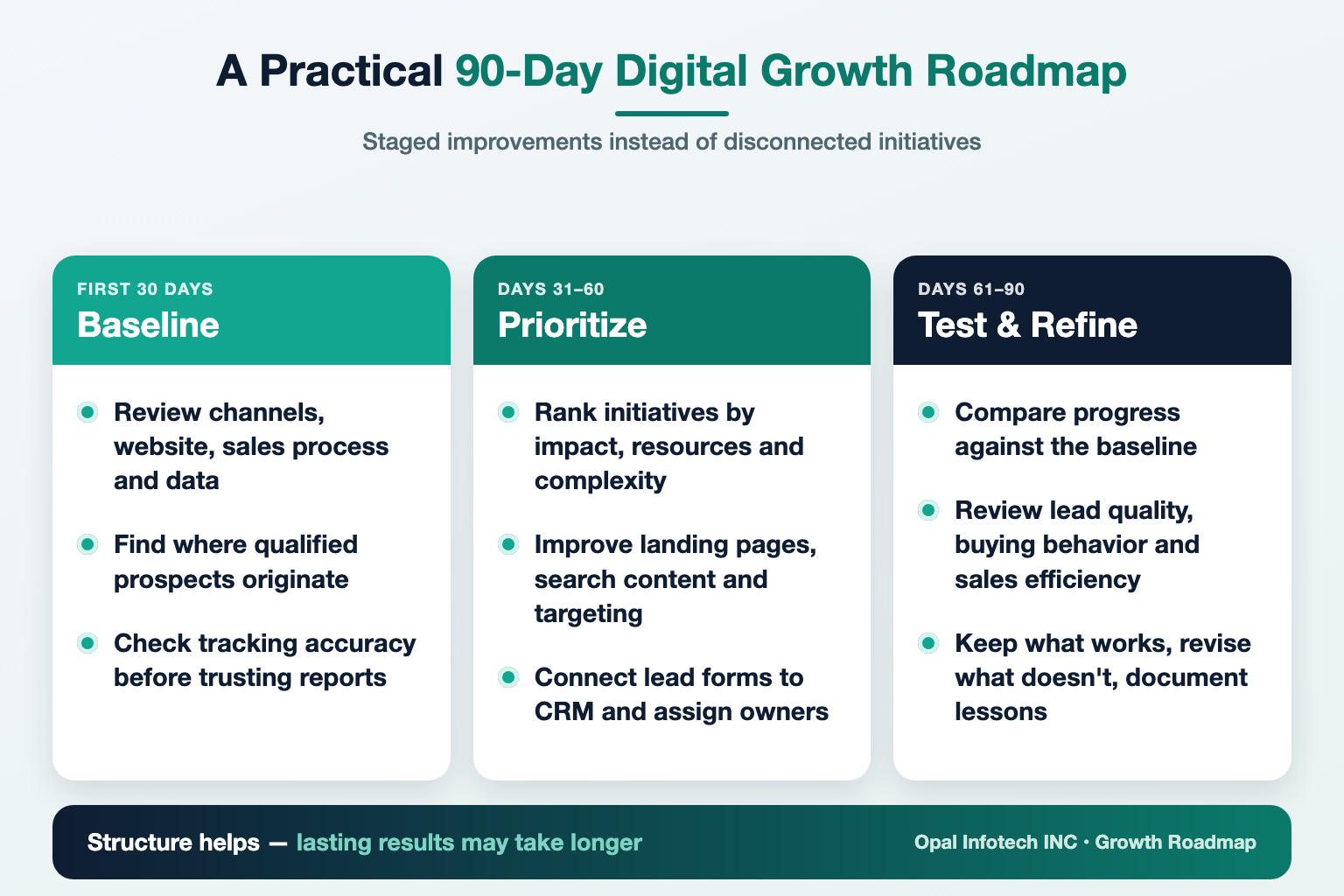
First 30 Days: Establish the Baseline
Begin by evaluating existing marketing channels, website performance, sales processes and customer data.
Identify where qualified prospects originate, which activities generate measurable business results and where information or operational gaps exist.
Review tracking accuracy before relying on performance reports.
Days 31–60: Prioritize High-Impact Opportunities
Select initiatives according to expected business impact, available resources and implementation complexity.
These may include improving priority landing pages, strengthening search content, adjusting advertising targeting or connecting lead forms with CRM software.
Assign ownership and establish measurable objectives for each initiative.
Days 61–90: Test, Learn and Refine
Review progress against the original baseline.
Evaluate whether changes have improved lead quality, purchasing behavior, sales efficiency or customer engagement. Continue successful initiatives, revise weak approaches and document lessons for subsequent planning cycles.
Set expectations: A 90-day roadmap creates structure, but meaningful results may require longer depending on the market, purchasing cycle and scale of implementation.
Why Businesses Should Work With an Integrated Digital Solutions Partner
Managing multiple disconnected service providers can create challenges when website development, digital marketing and operational technology need to work together.
An integrated digital solutions partner can help maintain consistency between technical implementation and commercial objectives.
At Opal Infotech INC, we bring extensive experience in web design and development, eCommerce solutions, SEO, digital advertising, AI-related services and custom business applications.
Our wider organization's history dates to 1998, providing experience across changing technologies, industries and online business models.
Our approach emphasizes understanding how each company's digital systems contribute to its customer journey. For B2B organizations, this can mean connecting technical content, targeted lead generation and organized inquiry management.
For eCommerce companies, it can involve coordinating product discovery, shopping functionality, advertising performance and customer engagement.
We recognize that organizations serving the USA and Canada operate in competitive and diverse environments. Their digital strategies should therefore reflect industry-specific requirements, regional priorities and long-term business ambitions.
Rather than assuming every company needs the same platform or marketing package, we focus on identifying solutions appropriate to its existing capabilities and growth objectives.
Conclusion: Sustainable Digital Growth Comes From Connecting the Entire Customer Journey
B2B and eCommerce success increasingly depends on how effectively businesses connect marketing, technology, sales and customer experience.
Attracting more visitors may create opportunities, but lasting commercial growth requires qualified demand, relevant information, efficient purchasing processes and dependable customer relationships.
For businesses operating in the United States and Canada, the most effective approach combines regional market understanding with measurable digital execution.
Search engine optimization helps establish visibility. Paid advertising can capture immediate demand. Content marketing supports informed purchasing decisions. CRM and automation improve follow-up processes, while analytics provide insight into commercial performance. Together, these capabilities create a connected foundation for business expansion.
Opal Infotech INC helps B2B enterprises and eCommerce brands plan and implement digital solutions aligned with their commercial priorities. By combining development expertise, digital marketing knowledge and practical technology capabilities, we support businesses seeking a more coordinated approach to online growth.
The next stage of digital success is not defined simply by how many people discover a company. It is shaped by how effectively that company understands customer requirements, delivers value and builds relationships that support future business.
Build a Digital Growth Engine That Connects the Entire Customer Journey
Talk to Opal Infotech INC about aligning SEO, advertising, automation, analytics and technology with your commercial goals.
Talk to Opal Infotech INC